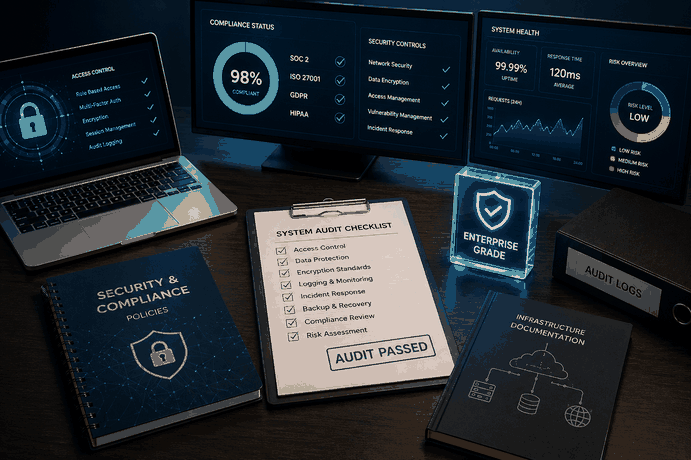
- Enterprise-grade means meeting quality and reliability standards any startup can achieve early.
- Compliance, security and scalability are harder to add later and must be built in from the start.
- Production-ready software needs observability, high availability and documented integrations.
- Enterprise customers judge system maturity before signing; failing security reviews loses deals.
- Building enterprise-grade initially costs less than retrofitting after landing your first big customer.
Why Enterprise-Grade Matters for Startups Not Just Large Companies
Enterprise-grade is a quality standard, not a company size. It means software handles mission-critical work reliably, securely and in compliance with industry rules. This is a different starting point than MVP development for startups. There, the goal is to validate an idea quickly, not to meet enterprise standards from day one.
Startups selling into enterprise customers, regulated industries or any B2B context where data security matters must meet enterprise-grade requirements. This is true regardless of their own size. A 15-person startup building for healthcare or finance needs to meet the same standards as a 5000-person company. The customer’s requirements do not adjust for your headcount.
Standard Software vs Enterprise-Grade System: The Difference at a Glance
Here is how both approaches compare across the dimensions enterprise customers evaluate.
| Area | Standard Software | Enterprise-Grade System |
|---|---|---|
| Security | Basic authentication and passwords | Role-based access, MFA, encryption, audit logs |
| Compliance | No formal framework | SOC 2, ISO 27001, GDPR or HIPAA built-in |
| Scalability | Works at expected load | Designed for spikes and horizontal scaling |
| Uptime | Accepts unplanned downtime | High availability with SLAs and failover |
| Integrations | Limited or manual data exchange | API-first with documented contracts |
| Observability | Basic error logs | Structured logging, tracing, alerting |
What Enterprise-Grade Systems for Startups Actually Require
Security Built Into the Architecture
Security is not an add-on but a foundation. Role-based access limits actions by user role. Encryption protects data at rest and in transit. Audit logs create tamper-evident records. Start with a clear security model on who can do what and how it is verified. This typically begins at the same stage where founders set up IT for a startup. Access controls and infrastructure choices made early are hard to change later. Our AI startup hiring case study covers the engineering hiring decisions that support this kind of security model. It looks at how one team built these standards in from the first hire. Building this in early is far cheaper than retrofitting.
Compliance That Is Built In Not Bolted On
SOC 2, ISO 27001, GDPR and HIPAA are not formalities. They are proof that your system handles data responsibly and that your controls are verifiable. Enterprise customers require this proof before they sign. Their security review processes will surface gaps your own team may not have noticed.
Compliance built in means controls are continuously monitored and evidence is always current. Compliance bolted on means a scramble before every customer audit. The former wins deals. The latter loses them.
Scalability That Does Not Require a Rewrite
A production-ready system handles current load and has a clear path to ten times that load without a complete rebuild. This means designing a scalable product architecture. It means separating components with different scaling profiles, and having visibility into where the system is under pressure before it becomes a production incident. Executing this well depends heavily on team strength. That is why startups that hire engineering talent faster tend to avoid the architectural shortcuts that cause problems later.
Startups that skip this discover the gap at the worst moment. A large customer onboards, load spikes to levels the system was never tested at, and this happens in front of the customer whose trust you need most. The principles behind scalable product architecture apply from the first line of production code, not only when a scaling problem becomes visible. Testing scalability assumptions earlier through a proof of concept is one way to catch this before it becomes a live incident.
Observability and Reliability in Production
Production-ready software works reliably under real conditions. It gives enough visibility into its behavior that problems are found before customers report them.
- Structured logging that captures what happened in each request without a production deploy to add context
- Distributed tracing to follow a request across services when something goes wrong
- Alerting tied to meaningful thresholds so the team knows about problems first
- Defined uptime SLAs with the architecture to support them including failover and recovery procedures
Build Once to Enterprise Standard, Not Twice
The argument against building to enterprise-grade standards early is cost. That is a fair concern, given how tightly most founders manage startup operational costs in the first place. The counter-argument is the cost of doing it twice. A startup that builds without security, compliance or observability often has to retrofit all three later. Retrofitting into a system not designed for them costs significantly more than building them in the first time. This retrofit cost is often the direct result of a poor handoff earlier on. Our guide on why development handoffs fail covers how that gap forms and how to prevent it.
More importantly, a startup that cannot pass a security review does not land the enterprise customer at all. The deal does not happen. The revenue that would have funded the rebuild never arrives.
This is the same pattern documented in a recent SaaS platform development case study. There, enterprise-readiness built in from day one shaped every major architecture decision and avoided a costly rebuild later.
Audit your current security model, compliance posture and observability stack. Identify the gaps before your next enterprise prospect finds them first.
Frequently Asked Questions
Enterprise-grade means the system meets the security, compliance, reliability and scalability standards enterprise customers require. They require these before trusting a vendor with their data and operations. For a startup this typically means verifiable security controls, alignment with a recognized compliance framework like SOC 2 or ISO 27001, high availability architecture, and documented APIs for integration. It is a quality standard, not a size category.
Because enterprise customers evaluate compliance before they sign, not after. A startup that arrives at a security review without SOC 2 or ISO 27001 alignment will lose the deal. This happens regardless of product quality. Building compliance in from the start also reduces cost significantly. Retrofitting controls into a system not designed for them takes far more time and effort than building them in early.
Software that works passes internal testing under expected conditions. Production-ready software is different. It handles real-world load reliably, gives enough observability to diagnose problems quickly, recovers from failures without manual intervention, and meets the uptime expectations of the customers depending on it. The gap between the two shows up most when a large customer onboards, or when something unexpected happens in production.
By designing clear component boundaries, API-first interfaces and data layers built for growth. The goal is to avoid rewrites while allowing future scaling, not to build for maximum load immediately. Start with the decisions that are hardest to change later: tenancy model, data layer design and API contracts. Keep everything else as simple as possible until scale demands more.