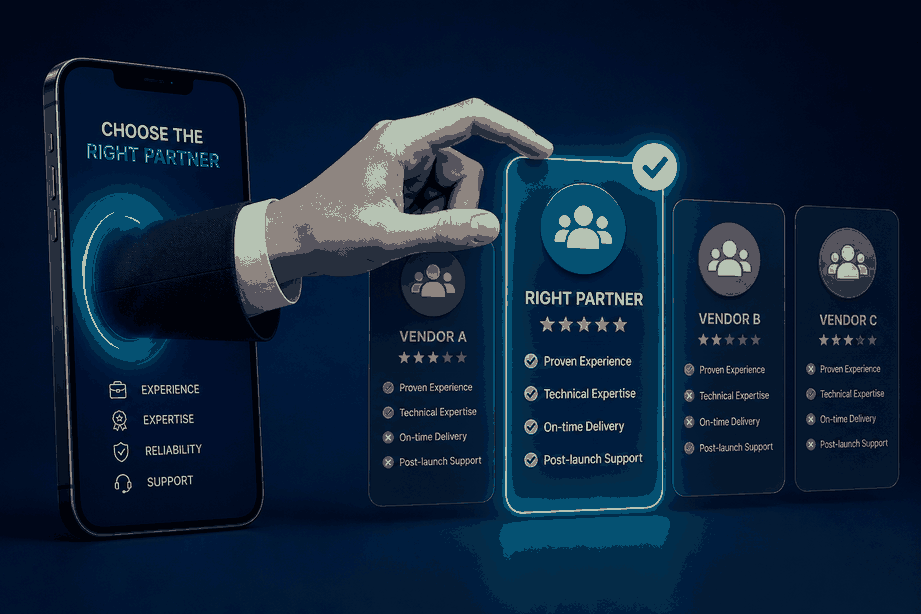
Founders, product managers and business owners who have a shortlist of mobile app development companies and need a structured way to evaluate proposals, test technical claims and make a vendor decision they can stand behind. If you're running a parallel evaluation for a software build rather than a mobile app, the same discipline applies, just with different criteria, our guide on how to narrow a shortlist of software development agencies covers that equivalent process.
- Platform claims need to be tested in conversation, not taken at face value. Any mobile app development agency can list iOS, Android, React Native and Flutter on their website. Ask them to walk through an architecture decision from a recent project. That conversation tells you what they actually know.
- A custom mobile app development company and a general development shop are not the same thing. Custom development requires deeper architecture thinking and better documentation practices. The evaluation criteria are different.
- Discovery ends with a signed document. Every scope dispute later traces back to what was and was not in it. Treat the signed discovery deliverable with the same weight as the contract itself.
- The proposal is not the project. Most of what makes a mobile app development engagement succeed or fail is not described in the proposal. It lives in how the agency handles discovery, manages scope changes and behaves when something goes wrong.
- Post-launch maintenance is not optional, but it is usually underspecified.Operating system updates break mobile apps. App store policy changes affect submissions. These are not exceptional events. They are the normal operating conditions of mobile app development services.
- App Store Optimization (ASO) must be scoped as its own deliverable covering keyword strategy, screenshots, preview videos, and rating management. It is not an afterthought.
The Evaluation Framework That Actually Works
Most vendor evaluations at the consideration stage come down to price, timeline and portfolio impressiveness. All three are the wrong primary criteria. This framework shifts weight toward the factors that actually predict delivery quality. Score each vendor on your shortlist across these dimensions before you compare pricing. The vendor who scores highest on evidence and lowest on presentation polish is usually the safer choice.
| Evaluation Dimension | Strong Signal | Weak Signal |
|---|---|---|
| Technical depth | Defends stack and architecture choices with project-specific reasoning when asked directly | Lists platforms and frameworks without connecting them to client problems |
| Portfolio quality | Provides live App Store and Play Store links from comparable projects | Shows screenshots, mockups or case study PDFs without live product access |
| Discovery approach | Structured discovery phase with a signed deliverable before build starts | Moves from brief to wireframe without documented requirements sign-off |
| QA and testing | Automated test coverage targets defined, QA runs throughout build not just at end | Testing described as a phase at the end, not a continuous process |
| Post-launch capability | Maintenance model described with SLA response times and monthly cost before contract | Support available on request, no defined structure or cost confirmed upfront |
| Commercial terms | IP ownership clause in standard contract, change-order process documented | IP ownership verbally confirmed, change management handled informally |
Comparing Mobile App Development Companies: What the Differences Actually Mean
The right vendor type for your project depends on your brief, your budget and how much internal capacity you have to manage the engagement. Choosing the wrong vendor type is more expensive than choosing the wrong company within the right type.
| Vendor Type | What It Usually Means in Practice | Best Fit |
|---|---|---|
| Full-service mobile app development agency | Integrated design, development, QA and project management under one roof. Higher coordination quality, higher day rate. | Projects where design and technical quality need to be aligned from the start. |
| Specialist mobile app development company | Deep iOS and Android expertise, sometimes with vertical focus. Less breadth, more depth. | Apps with complex native requirements: AR, health integrations, hardware APIs. |
| Custom mobile app development company | Builds from architecture up. No templates. Higher documentation standards and architectural rigour. | Products that cannot fit a standard template and need full IP ownership. |
| Nearshore or offshore mobile team | Lower day rates, comparable technical skills in many cases, requires stronger communication management. | Projects with a clear specification and a client who can manage the relationship actively. |
| Freelance network or marketplace | Low overhead, wide talent pool, no integrated team accountability. | Discrete, well-defined tasks. Not suitable for full-cycle product builds. |
The Questions That Separate a Good Mobile App Development Agency from a Great One
Most discovery calls follow a predictable pattern. The agency presents its process, shows portfolio work and asks what you are building. The buyer answers and a proposal follows. None of that differentiates. The questions below reveal how an agency actually operates.
About technical decision-making
- Walk me through a project where the client asked for something you recommended against. What was it and how did the conversation go?
- On your last React Native project, what was a situation where you chose not to use a third-party library and why?
- How do you handle a situation where a new iOS API changes the behaviour of a feature that is already in production?
About process and delivery
- What does your discovery deliverable look like and can you share an anonymised example from a past project?
- At what point in your process does QA get involved and how is test coverage tracked?
- What is your approach when a scope addition is requested mid-sprint and the client wants it in the current release?
About commercial accountability
- Where does IP ownership sit in your standard contract and can we see the relevant clause before proposals are exchanged?
- How is your post-launch maintenance structured and what does a typical monthly retainer include?
- Can we speak with a reference from a project of comparable scope before we proceed to proposal stage?
If any of the questions above produces a deflection, a redirect to the portfolio or a comment about how it depends on the project, that is not an answer. An agency that takes its work seriously can answer these specifically. One that cannot has not operated at the level of accountability these questions assume.
Custom Mobile App Development: When You Need It and What to Demand
Custom mobile app development is not a premium version of standard mobile development. It is a different discipline with different requirements, different documentation standards and a different relationship to architecture.
Signs your project actually needs custom development
- Your business logic is specific enough that a standard template or white-label product would require more workarounds than it saves.
- You need full ownership of the codebase and complete independence from a third-party platform’s roadmap.
- Your compliance requirements, such as HIPAA, PCI DSS or FedRAMP, mandate security architecture decisions that cannot be made within a platform constraint. This is the same groundwork required for enterprise-grade systems more broadly, security bolted on after launch costs multiples of what it costs to design in from the start.
- Your app needs deep integration with proprietary backend systems or industry-specific APIs that no template supports.
- If none of these apply cleanly to your project, it's worth revisiting whether an MVP-first approach for startups makes more sense than committing to a full custom build right away.
What to require from a custom mobile app development company
| Requirement | Why It Matters at This Stage |
|---|---|
| Architecture document produced before build starts | Custom architecture choices made without documentation become undocumented debt. Future teams cannot maintain or extend what they cannot understand. |
| Automated test coverage target in the contract | Custom builds carry higher risk of regression. Coverage targets that are acceptance criteria create accountability. Targets that are aspirations get cut at launch. |
| SRS sign-off before sprint 1 | Custom development cannot recover from undocumented requirements. The SRS is the single source of truth for every scope conversation that follows. |
| Named architects committed to the engagement | Architecture quality degrades when the person who designed the system is not available to explain it. Named assignment in the contract prevents this. |
| Documentation as a named contract deliverable | Custom systems are useless without documentation. Promising it at handover almost always means it does not happen. |
Getting the architecture document right at this stage is what separates scalable product architecture from a codebase that needs rebuilding once the app outgrows its first version.
Mobile App Development Services: What the Scope Actually Covers
Most buyers evaluate mobile app development services based on the headline deliverable, the app. The services that determine whether the app performs commercially are usually underspecified in the brief and underweighted in the evaluation.
| Service Area | What Good Coverage Looks Like | What to Watch Out For |
|---|---|---|
| UX and product design | Design system produced, platform guidelines (HIG and Material Design) referenced explicitly, interactive prototype before development | Wireframes only, no design system, no platform-specific consideration |
| Backend and API development | API contract defined and documented before build, backend team allocated not outsourced | Backend described as existing or not in scope without explicit plan |
| Analytics and instrumentation | Event taxonomy defined in discovery, analytics instrumented from sprint 1, dashboards delivered at launch | Analytics available on request post-launch, no instrumentation plan at start |
| App Store Optimisation (ASO) | Keyword strategy, screenshot design and metadata produced as launch deliverables | App store listing managed by client, no agency involvement |
| Compliance and security | Security model defined at architecture level, platform-specific security APIs used, third-party penetration test at launch for high-risk apps | Security described as a general best practice rather than a specific implementation plan |
| Post-launch maintenance | Monthly retainer confirmed with SLA tiers and cost before project start | Maintenance quoted separately after launch at undefined rates |
Use this guide to ask the right questions and make an informed, confident choice for your mobile app development partner.Once you’ve made your choice, starting your mobile app development project the right way means locking in IP ownership, named engineers and post-launch terms before the first sprint begins.
Ready to Choose Your Partner?
If your evaluation also includes a backend platform or admin system being built separately, starting your project with a software development agency follows a similar logic, named engineers, signed discovery and clear IP terms all matter there too. The vendors worth choosing are easy to identify once you ask the right questions. They talk about their work with specificity. They welcome contract scrutiny. They run discovery as a commitment to outcomes rather than a formality before billing starts.
Bring your shortlist and your brief. We will walk through the evaluation framework, flag what is missing from each proposal and help you make a confident decision. No pitch. No obligation. Book your free 30-minute evaluation session with our team.
Frequently Asked Questions
Ask for live App Store or Play Store links from projects on that specific platform, then download the app and test it. Performance, navigation quality and how it handles edge cases like losing network connection tell you things a portfolio PDF never will. If the company cannot provide live links from comparable projects, the claim of platform specialisation is marketing, not evidence. A conversation about a specific technical decision on that platform, for example a state management trade-off in Flutter or a SwiftUI migration decision, will also reveal depth that a capability list cannot fake.
Ask each vendor to confirm in writing exactly what is included for testing, documentation, post-launch SLA and App Store submission. These are the four areas where proposals most commonly diverge without making that divergence visible at the summary level. Once you have the same list of inclusions confirmed by both vendors, the price comparison becomes meaningful. The vendor with a lower price and identical confirmed inclusions is either more efficient or taking on a margin risk that will show up somewhere in delivery. Ask which it is directly.
The platform choice affects architecture from the first design decision. A cross-platform build using React Native or Flutter produces one codebase that compiles to both platforms, which reduces development cost and maintenance overhead at the price of some platform-specific behaviour. Separate native builds give you full platform conformity but require maintaining two codebases. Most experienced mobile app development companies will recommend cross-platform for most commercial products, and native for products that require deep hardware integration, real-time performance or platform-specific regulatory compliance. If a vendor recommends native for a project that does not justify it, ask them to quantify the performance advantage against the maintenance cost.
The right framing is total cost of ownership rather than initial build cost. A standard build using templates or white-label components is cheaper upfront and slower to accumulate technical debt, but only if your requirements fit the template. When your requirements drift outside the template, each customisation becomes more expensive than it would have been in a custom build from the start. The decision point is an honest assessment of how differentiated your business logic is. If your app does something that a general template does not support, custom development is the cheaper option over a three to five year horizon even when the upfront investment is higher.
A full-service agency integrates design, development, QA and project management under one roof. The coordination quality is higher because design and engineering decisions are made by the same team, and the day rate reflects that. A specialist mobile app development company offers deeper iOS and Android expertise, sometimes with a vertical focus such as healthcare or fintech, but less breadth across other disciplines. The right choice depends on whether your project needs that depth of native expertise or whether integrated cross-discipline quality is the more important factor. For most commercial products, a full-service agency with strong mobile credentials is the lower-risk option. For apps with complex native requirements such as AR, health integrations or hardware APIs, a specialist is worth the narrower scope.
A proper discovery phase produces signed, written deliverables before a line of code is written. At minimum this should include: a documented requirements specification covering functional and non-functional requirements; a defined event taxonomy for analytics instrumentation; an API contract outlining all backend integration points; a platform decision rationale if the brief includes both iOS and Android; and a security model defining how platform-specific security APIs will be used. Discovery should be charged for, not offered as a free pre-sales activity. An agency that offers discovery for free is signalling that they do not treat it as professional work, which predicts how they will handle ambiguity mid-project.
Post-launch maintenance terms should be confirmed before you sign the build contract, not negotiated separately after launch. Ask for the maintenance model in writing covering: SLA response tiers for critical bugs, standard bugs and enhancement requests; monthly or annual retainer cost with clear inclusions; how operating system updates and app store policy changes are handled; and who is responsible for App Store submission renewals. An agency that cannot describe a structured maintenance model before the project starts will not have one ready when you need it. Maintenance as an afterthought is one of the most common causes of post-launch cost surprises in mobile app development.
Four clear signals indicate custom development is the right choice. First, your business logic is specific enough that a standard template would require more workarounds than it saves. Second, you need full codebase ownership and independence from any third-party platform roadmap. Third, your compliance requirements, such as HIPAA, PCI DSS or FedRAMP, mandate security architecture decisions that cannot be made within a platform constraint. Fourth, your app requires deep integration with proprietary backend systems or industry-specific APIs that no template supports. If two or more of these apply, the cost of adapting a template over 18 to 24 months will exceed the upfront cost of building custom from the start.