What Is a Marketing Strategy?
A marketing strategy is a company’s long term plan for reaching its target audience, communicating its value proposition and converting prospects into paying customers. It is the operating system beneath every campaign, channel decision and piece of content your team produces.
The term is widely misused. A content calendar is not a marketing strategy. An annual paid media budget is not a marketing strategy. A quarterly campaign plan is not a marketing strategy. These are tactics, outputs of a strategy, not the strategy itself. A true marketing strategy answers five foundational questions before any tactic is chosen:
- Who are you targeting? The specific buyer, their industry, role, company size, pain triggers and buying behaviour.
- What is your value proposition? The precise, differentiated outcome your product delivers that the buyer cannot easily get from an alternative.
- How do you position against alternatives? Where you sit in the buyer’s mind relative to competitors and substitutes.
- Which channels will you use to reach them? The specific channels selected based on where your ICP actually spends attention.
- How do you define and measure success? The specific KPIs, at each funnel stage, that tell you whether the strategy is working.
Strategy vs. plan vs. campaign: A marketing strategy sets direction for 12-36 months. A marketing plan translates strategy into quarterly tactical execution. A campaign is a specific, time bound activation within that plan.
The 4 Ps of Marketing
The foundational framework for building any marketing strategy is the marketing mix, commonly called the 4 Ps. Despite being decades old, it remains the most useful first principles structure for grounding strategy decisions.
What you’re selling, how it’s packaged and whether it genuinely solves the buyer’s most pressing problem. A weak product cannot be marketed into success.
How you price relative to value delivered, competitors and what the market will bear. Pricing is the fastest lever in any strategy a 1% pricing improvement outperforms a 1% volume gain.
Where and how buyers discover, evaluate and purchase your product channels, partner ecosystems, marketplaces and distribution networks.
How you communicate the value proposition to the right audience the specific mix of channels, messaging, content and campaigns that drive awareness and demand.
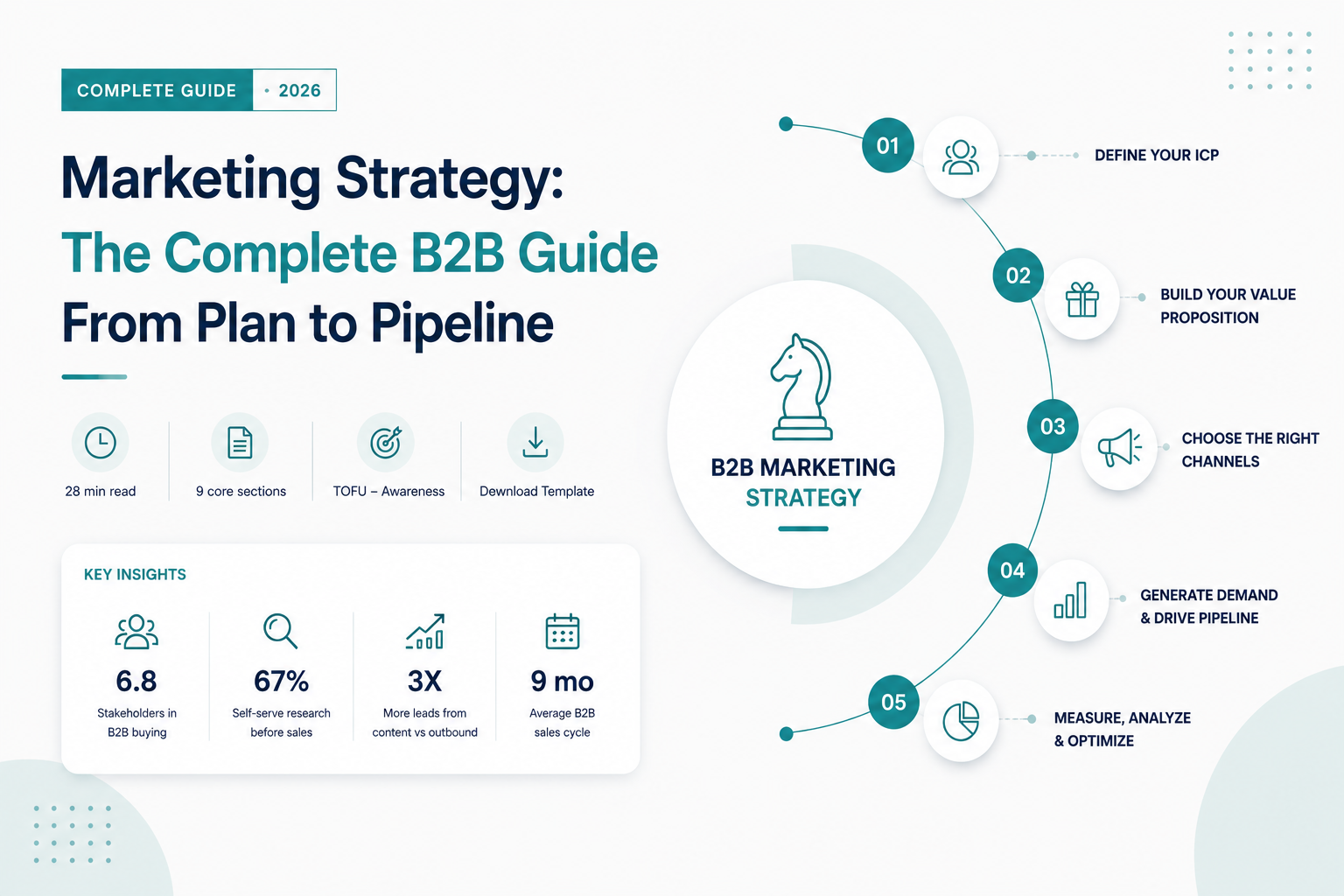
The 2026 fifth P: For B2B specifically, add Proof: customer case studies, benchmarks, third party validation and quantified ROI evidence. In an era where 67% of B2B buyers complete self serve research before any sales contact, proof is the mechanism by which buyers convince their buying committee to move forward.
What Is Business to Business Marketing?
Business to business marketing (B2B marketing) is the practice of promoting products or services from one company to another, rather than to individual consumers. Most failed B2B marketing strategies are built on B2C assumptions.
How B2B Marketing Differs from B2C Marketing
| Dimension | B2B Marketing | B2C Marketing |
|---|---|---|
| Buyer | Organisations multiple stakeholders (economic buyer, champion, technical evaluator, end user) | Individual consumers making personal decisions |
| Purchase cycle | 3 months to 2+ years procurement, legal, security reviews | Minutes to days impulse or considered purchase |
| Decision driver | ROI, risk reduction, strategic alignment, vendor track record | Emotion, desire, social proof, price, convenience |
| Content type | Case studies, whitepapers, ROI calculators, webinars, demos | Short form video, user generated content, influencer, display ads |
| Primary channels | LinkedIn, content/SEO, email nurture, ABM, events | Instagram, TikTok, Google Shopping, influencer, TV/streaming |
| Relationship | Long term vendor partnership renewals, expansion, NRR | Transactional repeat purchase driven by loyalty programmes |
“The single most common B2B marketing mistake is using B2C urgency tactics on buyers who make decisions by committee on a 9-month cycle. Speed to purchase cannot be manufactured, trust must be built.”
State of B2B Marketing, 2026
The B2B Buying Committee
Unlike B2C, most B2B purchases involve a buying committee , multiple people with different priorities, different information needs and different definitions of success.
Controls the budget. Cares about ROI, payback period and strategic fit. Needs financial proof and executive level case studies. Often not in early discovery they appear at approval stage.
Advocates internally for your solution. Likely found your product through organic research. Needs arming with talking points, competitive comparisons and ROI data to win internal budget approval.
Assesses integration, security, compliance and scalability. Needs documentation, API specs, security certifications and technical case studies not benefit led marketing copy.
How to Build a B2B Marketing Plan in 7 Steps
A B2B marketing plan translates your strategy into a documented, executable roadmap. It answers not just what you’ll do, but who owns it, what it costs and what success looks like at every milestone.
- Set SMART Marketing Objectives. Define what success looks like in specific, measurable terms not “increase brand awareness” but “generate 150 MQLs per month by Q3 from organic search and LinkedIn.”
- Define Your Ideal Customer Profile (ICP). Lock your ICP across three layers: firmographic (industry, size, revenue, funding stage), technographic (existing tech stack) and behavioural (pain triggers, buying signals, decision timeline).
- Conduct Competitive and Market Analysis. Analyse direct competitors, indirect competitors and the status quo. Map your differentiation against each and validate it with customers, not internally.
- Define Positioning and Messaging. Build a messaging hierarchy: a single value proposition → three proof pillars → persona level translations for each member of the buying committee.
- Select Your Channel Mix. Choose 2-3 primary channels based on ICP behaviour, your ACV and your team’s execution capability. High performing B2B teams generate 80% of pipeline from ≤3 channels.
- Allocate Budget by Channel and Stage. The typical B2B split is 40% top of funnel, 35% mid funnel, 25% bottom of funnel.
- Define Your Metrics Dashboard and Review Cadence. Set KPIs at each funnel stage before launch. Run weekly channel reviews, monthly funnel reviews and quarterly strategy retrospectives.
B2B Marketing Channels: The Complete 2026 Map
B2B marketing channels are not interchangeable. Each channel has a specific audience profile, a typical ACV range where it performs, a characteristic time to pipeline and a distinct set of execution requirements.
Organic / Long Term Compounding Channels
- Content Marketing & SEO: Time to pipeline 6-12 months. Very high ROI potential. Works for any ACV.
- Generative Engine Optimization (GEO): Time to pipeline 3-9 months. AI powered search now rivals Google for enterprise software discovery. Leads from AI search convert 40% better than traditional search.
- Thought Leadership / LinkedIn Publishing: Builds authority and trust with buyers in the awareness stage.
- Community Led Growth: Long term compounding. Drives referrals and word of mouth at scale.
Paid / Immediately Scalable Channels
- LinkedIn Ads (ABM targeting): Time to pipeline 1-3 months. Best for $15K+ ACV. High execution complexity.
- Google Paid Search: Immediate pipeline. Medium ROI. Best for $5K+ ACV.
- Intent Data Advertising: Targets buyers actively researching your category.
- Retargeting / Display: Re engages visitors who have already shown interest.
Relationship & High Touch Channels
- Account Based Marketing (ABM): Time to pipeline 2-5 months. High ROI for $25K+ ACV. Very high execution complexity.
- Webinars & Virtual Events: Time to pipeline 1-4 months. High ROI for $10K+ ACV.
- In Person Events & Conferences: Builds relationships and accelerates late stage deals.
- Partner & Co Marketing: Extends reach through trusted channels without proportional cost increase.
B2B Content Strategy: Mapping Content to the Funnel
Content is the primary mechanism by which B2B buyers self educate before they ever speak to your sales team. A B2B content strategy maps every piece of content to a specific funnel stage, a specific persona and a specific desired action.
- Top of Funnel (Awareness): SEO optimised guides, thought leadership articles, data research reports, podcast appearances, GEO structured explainers. Metrics: organic traffic, impressions, brand search volume.
- Mid Funnel (Consideration): Case studies, comparison pages, webinars, email nurture sequences, ROI calculators. Metrics: MQL volume, demo requests.
- Bottom of Funnel (Decision): Free trials, competitor battlecards, security documentation, pricing pages, customer references. Metrics: SQL conversion, win rate, CAC.
The content distribution mistake: Most B2B teams spend 90% of effort on content creation and 10% on distribution. A single high quality piece of content distributed across 8 channels outperforms eight average pieces distributed through one. Build distribution into every content brief before writing begins.
Measuring Marketing Strategy Success
A marketing strategy without a measurement framework is a hypothesis. B2B marketing metrics fall into three categories: acquisition, revenue and retention and all three must be tracked simultaneously.
- Awareness: Organic traffic growth, brand search volume: reviewed monthly.
- Consideration: MQL volume by channel, MQL to SQL conversion rate: reviewed weekly.
- Revenue: Marketing sourced pipeline, CAC by channel, average ACV: reviewed monthly.
- Retention: Net Revenue Retention (NRR), Expansion MRR: reviewed monthly.
The NRR imperative: Best in class B2B marketing strategies treat Net Revenue Retention as a marketing metric, not just a CS metric. If existing customers aren’t expanding, no amount of top of funnel investment fixes a leaky retention bucket.
Benefits of a Marketing Strategy
- Focused Resource Allocation: Teams with documented marketing strategies consistently report 25-35% lower blended CAC.
- Consistent Brand Messaging: A positioning and messaging framework ensures every touchpoint communicates the same value proposition.
- Shorter Sales Cycles: Buyers educated by top of funnel content arrive at sales conversations with pre existing trust, compressing average deal cycle by 20-35%.
- Compounding Content Returns: Organic content marketing has a compounding return profile, content published today continues to generate traffic and MQLs for 2-5 years.
- Sales and Marketing Alignment: A shared ICP definition and MQL to SQL handoff criteria ends the most common source of revenue team conflict.
- Predictable Revenue Contribution: With documented conversion rates, marketing teams can accurately forecast pipeline contribution 90-180 days out.
- Competitive Differentiation: A defined positioning strategy prevents reactive messaging changes when competitors launch features.
- Faster Team Onboarding: New hires onboarded into documented environments reach full productivity 40-60% faster.
Frequently Asked Questions
A marketing strategy is a company's long term plan for reaching its target audience, communicating its value proposition and converting prospects into paying customers. It defines who you target, why they should care and how you'll reach them , it is not a campaign, a content calendar or a budget document.
A B2B marketing plan translates your strategy into a documented, executable roadmap. It covers objectives, ICP definition, competitive analysis, positioning, channel mix, budget allocation, content strategy, campaign calendar and metrics dashboard, with clear owners and review cadences.
The highest ROI B2B marketing channels are content marketing/SEO (very high long term ROI), generative engine optimisation (GEO for AI search), LinkedIn ABM (for $15K+ ACV), email nurture and webinars. The right channel mix depends on your ICP, ACV and growth stage, not trend reports.
A marketing strategy sets the direction for 12-36 months: who you target, your value proposition, positioning and channel philosophy. A marketing plan translates that strategy into quarterly tactical execution with specific campaigns, budgets, owners and KPIs. Strategy comes first; the plan executes it.
Measure across three funnel stages: awareness (organic traffic, brand search volume), consideration (MQL volume, MQL to SQL conversion rate) and revenue (marketing sourced pipeline, CAC by channel, average ACV). Also track retention metrics, NRR and expansion MRR, as indicators of strategy effectiveness downstream.