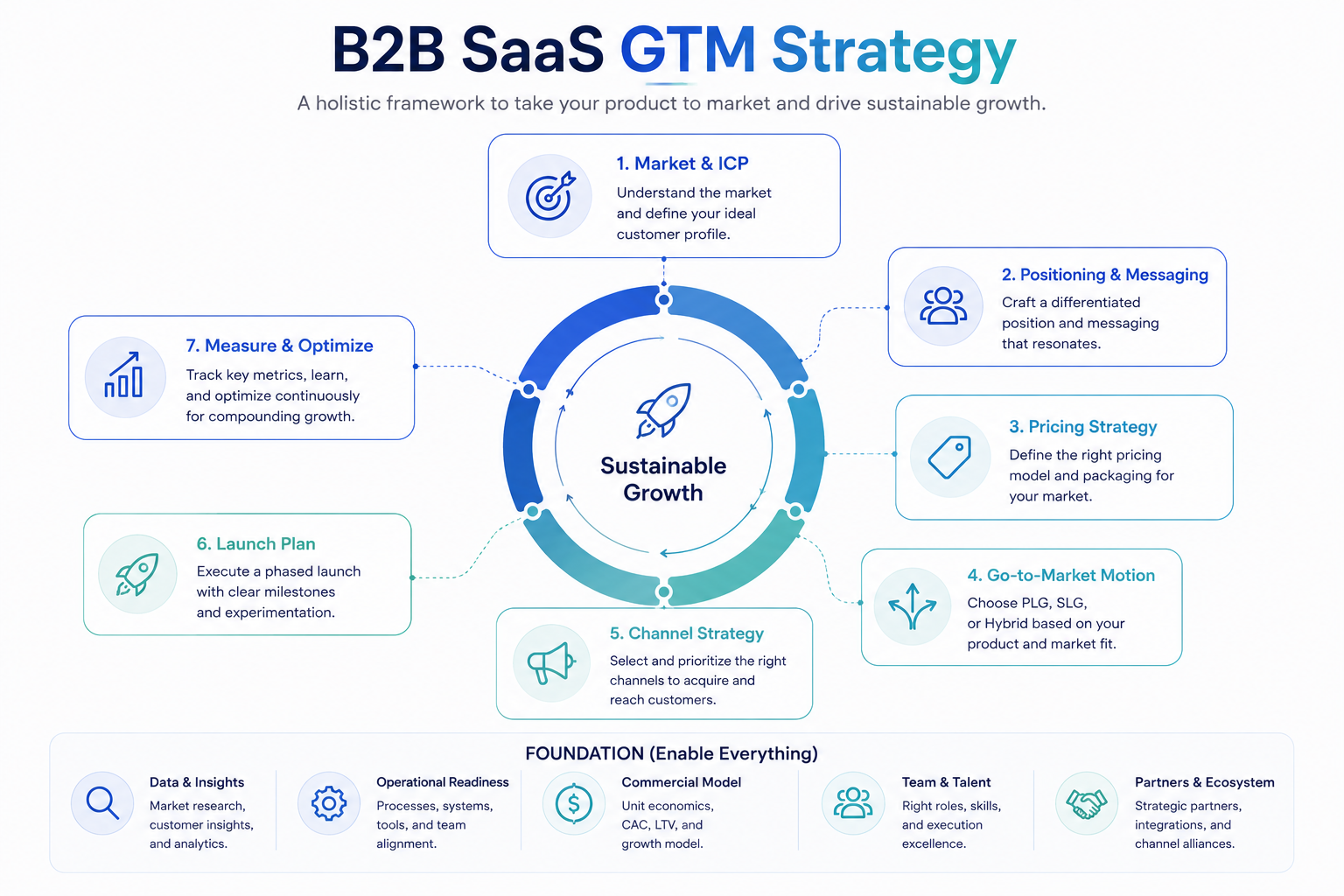
What Is a B2B SaaS GTM Strategy (and What It Is Not)?
A B2B SaaS go to market strategy is your system for turning a product into repeatable revenue. It answers five questions in sequence: Who is the buyer? Why should they care? Where do they discover you? How do you convert them? And what does success look like across the funnel?
Most early stage SaaS companies confuse GTM with marketing. Marketing is one input within a GTM strategy, the part that generates awareness and demand. A true GTM strategy for a software company integrates pricing, sales motion, product decisions, channel mix, positioning and feedback loops as a single operating system.
| Dimension | GTM Strategy | Marketing Plan | Business Plan |
|---|---|---|---|
| Scope | Product → Revenue system | Awareness & demand gen | Entire business operations |
| Timeframe | 90-day sprints, quarterly review | Campaign level (weeks/months) | 1-5 year horizon |
| Owns | Cross functional (Product, Sales, Marketing, CS) | Marketing team | Executive / founders |
| Key output | Pipeline velocity & revenue | Leads & brand awareness | Funding, P&L, strategy |
The 2026 B2B SaaS GTM Landscape
Before building a GTM framework, understand the macro environment your strategy must navigate:
ICP Definition: The Foundation of Every SaaS Go to Market Plan
Every failed GTM audit shares one trait: a vague Ideal Customer Profile. “Any company that needs project management software” is not an ICP, it is a wish. Your SaaS go to market plan only compounds when you know exactly which companies will buy, why they will buy and when they will buy.
The Three Layer ICP Framework
Define your ICP across three distinct dimensions, layered from broadest to most precise:
Market Sizing: Bottom Up Over Top Down
Top down sizing (“The global CRM market is $69B”) impresses on pitch decks and has near zero operational value. Bottom up sizing, counting actual companies that can realistically buy at your price point, tells you how many sales opportunities exist and whether your targets are achievable.
| Tier | Definition | How to Calculate | Useful For |
|---|---|---|---|
| TAM | Total Addressable Market | All companies that could theoretically buy a product in your category | Investor narrative, category sizing |
| SAM | Serviceable Addressable Market | Companies matching your ICP firmographics at your price point | Sales territory planning |
| SOM | Serviceable Obtainable Market | Companies you can realistically reach and convert in 12-24 months | Revenue forecasting, hiring plans |
PLG vs. SLG vs. Hybrid: Choosing Your GTM Motion
The most consequential architectural decision in any GTM strategy for a software company is the sales motion. This determines how customers discover, evaluate and purchase your product and misaligning it with your ACV and buyer behavior burns more capital than any other early mistake.
Choose PLG when…
- ACV is under $10K/year
- Time to value is under 10 minutes
- End users can purchase directly
- Self serve onboarding is feasible
- Network effects exist in the product
- Freemium or free trial drives acquisition
Choose SLG when…
- ACV exceeds $25K/year
- 3+ stakeholders involved in buying
- Compliance or security reviews required
- Integration complexity needs guidance
- Procurement / legal cycle is long
- Switching costs are high for the buyer
When to Use a Hybrid GTM Motion
A hybrid motion pairs a PLG entry point (freemium, self serve trial) with a sales overlay for expansion into larger accounts or enterprise tiers. This works when you have a product that individuals or small teams adopt easily, but where organizational level deployment requires a relationship.
Positioning and Messaging for B2B SaaS
Positioning is not your tagline. It is the deliberate choice of where your product sits in the buyer’s mind relative to alternatives, including the status quo (doing nothing or using spreadsheets). Poor positioning is why technically superior products lose to inferior competitors.
The Positioning Canvas
Messaging Hierarchy
Translate positioning into a messaging hierarchy that every team member can execute consistently:
Single Value Proposition (the promise)
One sentence describing the outcome your best customers achieve. Leads with result, not features. Quantified where possible.
Three Proof Pillars (the argument)
Three distinct capability areas that explain how you deliver the value proposition. Each pillar should be supported by at least one quantified customer story.
Persona Level Messaging (the translation)
Re express each pillar in the language of the specific buyer, what a CFO cares about differs from what the head of engineering cares about, even for the same product.
Objection & Comparison Responses (the defense)
Pre written responses to the five most common objections and head to head comparisons with the top two alternatives buyers will evaluate alongside you.
SaaS Pricing Strategy: Getting It Right the First Time
Pricing is the fastest lever in your SaaS go to market plan, a 1% improvement in pricing yields more profit impact than a 1% improvement in volume. Yet most founders either copy a competitor’s pricing model or guess based on gut feel.
| Model | Best For | NRR Potential | Complexity |
|---|---|---|---|
| Flat rate | Simple products, SMB buyers, low variance in usage | Medium | Low |
| Per seat | Collaboration tools, team based workflows | High | Low |
| Usage based | API products, infrastructure, high volume consumers | Very High | High |
| Tiered | Products with feature depth across buyer segments | High | Medium |
| Value based | Enterprise deals with measurable ROI, custom contracts | Very High | Very High |
Channel Strategy: Where to Find Your B2B SaaS Buyers
Channel selection is where most GTM strategies for software companies scatter their resources. The temptation to “be everywhere” burns budget and produces mediocre results across all channels. The highest performing GTM teams generate 80% of pipeline from ≤3 channels and they choose those channels based on ICP behavior, not trend reports.
Channels by GTM Motion
Product Led Growth Channels
Sales Led Growth Channels
Cross Motion Channels
Channel Prioritization Framework
| Criterion | Questions to Ask | Weight |
|---|---|---|
| ICP Presence | Are your ICP buyers actually discoverable and reachable via this channel? | High |
| Payback Period | How many months until channel investment returns positive CAC ratio? | High |
| Execution Capability | Do you have the team, tools and content to run this channel well today? | Medium |
| Defensibility | Can competitors easily replicate your presence on this channel? | Medium |
| Scalability | Does channel output grow with investment or does it plateau quickly? | Medium |
B2B Product Launch Strategy: The 3-Phase GTM Timeline
A successful B2B product launch strategy is not an event, it is a phased revenue system. Treating launch as a single moment (press release + demo day) is why pipeline spikes post announcement and then craters. Structure your launch as three distinct phases with explicit success criteria at each gate.
- Lock ICP definition and buyer persona documentation
- Finalize pricing model and tier structure
- Build sales enablement materials (battlecards, demo scripts)
- Set up analytics stack and attribution model
- Create 10-15 foundational SEO content pieces
- Identify and onboard 5-10 design partner / beta customers
- Activate 1-2 primary acquisition channels
- Run weekly win/loss review cadence
- Measure time to value and activation rates
- Document the first 3 closed won customer stories
- Refine ICP based on who actually converts
- Establish NPS and CSAT baseline
- Scale winning channels to full budget allocation
- Hire first dedicated AE or growth marketer against proven playbook
- Activate secondary channels (partner program, referrals)
- Launch customer expansion / upsell motion
- Publish first annual GTM retrospective & next quarter plan
- Build toward ≥110% NRR as core retention KPI
GTM Metrics: What to Measure and When
Benefits of a B2B SaaS GTM Strategy
A well executed GTM strategy is not overhead, it is the primary driver of capital efficiency, revenue predictability and competitive moat. Here are the measurable organizational benefits that compound over time when your GTM is built as a system:
Your GTM Strategy Document: What to Include
A functional SaaS go to market plan document is not a 40-page deck no one reads. It is a living reference that every team member can access, execute against and update as you learn. These are the ten components every GTM document must include:
- Market Sizing: TAM/SAM/SOM with bottom up calculation, data sources cited
- ICP Definition: Firmographic + technographic + behavioral layers, with exclusion criteria
- Buyer Persona Cards: Primary buyer, economic buyer, technical evaluator, goals, pains, success metrics
- Positioning Statement: One sentence value prop + three proof pillars + category declaration
- Pricing Model: Chosen model, rationale, tier structure and discounting policy
- Sales Motion Selection: PLG / SLG / Hybrid decision with criteria and handoff definitions
- Channel Playbook: Primary channels (2-3), budget allocation, KPIs per channel, quarterly review cadence
- Launch Timeline: Pre launch / soft launch / full launch milestones with go/no go criteria at each gate
- Metrics Dashboard: Core acquisition, revenue and retention KPIs with owners and update frequency
- GTM Anti Patterns: Documented list of what not to do (tactics that failed in discovery, segments to avoid)
Frequently Asked Questions
A B2B SaaS go to market (GTM) strategy is a structured plan defining how a software company brings its product to market, acquires customers, and generates recurring revenue. It covers ICP definition, pricing, sales motion (PLG or SLG), channel selection, messaging, and launch sequencing — all functioning as an integrated system rather than isolated tactics.
Choose PLG if your ACV is under $10K, the product delivers value quickly (under 10 minutes time to value), end users can influence the purchase, and self serve onboarding is feasible. Choose SLG if ACV exceeds $25K, buying requires multiple stakeholders, or compliance/security reviews are common. Hybrid models work when you have a freemium entry point but need sales for enterprise expansion.
A complete SaaS go to market plan should include: market sizing (TAM/SAM/SOM), a precise ICP with firmographic, technographic, and behavioral layers, positioning and messaging framework, pricing model, sales motion selection, channel strategy, a phased launch timeline with 90-day milestones, and core metrics with defined success criteria.
The best channels depend on your ACV and sales motion. For PLG: organic SEO, product review sites (G2, Capterra), community led growth, and content marketing typically deliver the strongest ROI. For enterprise SLG: LinkedIn ABM, targeted outbound sequences, executive events, and partner channels perform best. Most successful B2B SaaS companies use a blended approach with 2-3 primary channels generating 80% of pipeline.
A complete GTM strategy execution typically runs in three phases: pre launch (weeks 1-8) covering ICP validation, messaging, and channel setup; soft launch (weeks 9-16) with beta customers and metric baselining; and full launch (weeks 17-24+) with scaled channel investment and sales hiring. Expect 6-12 months before GTM compounding becomes clearly visible in metrics.