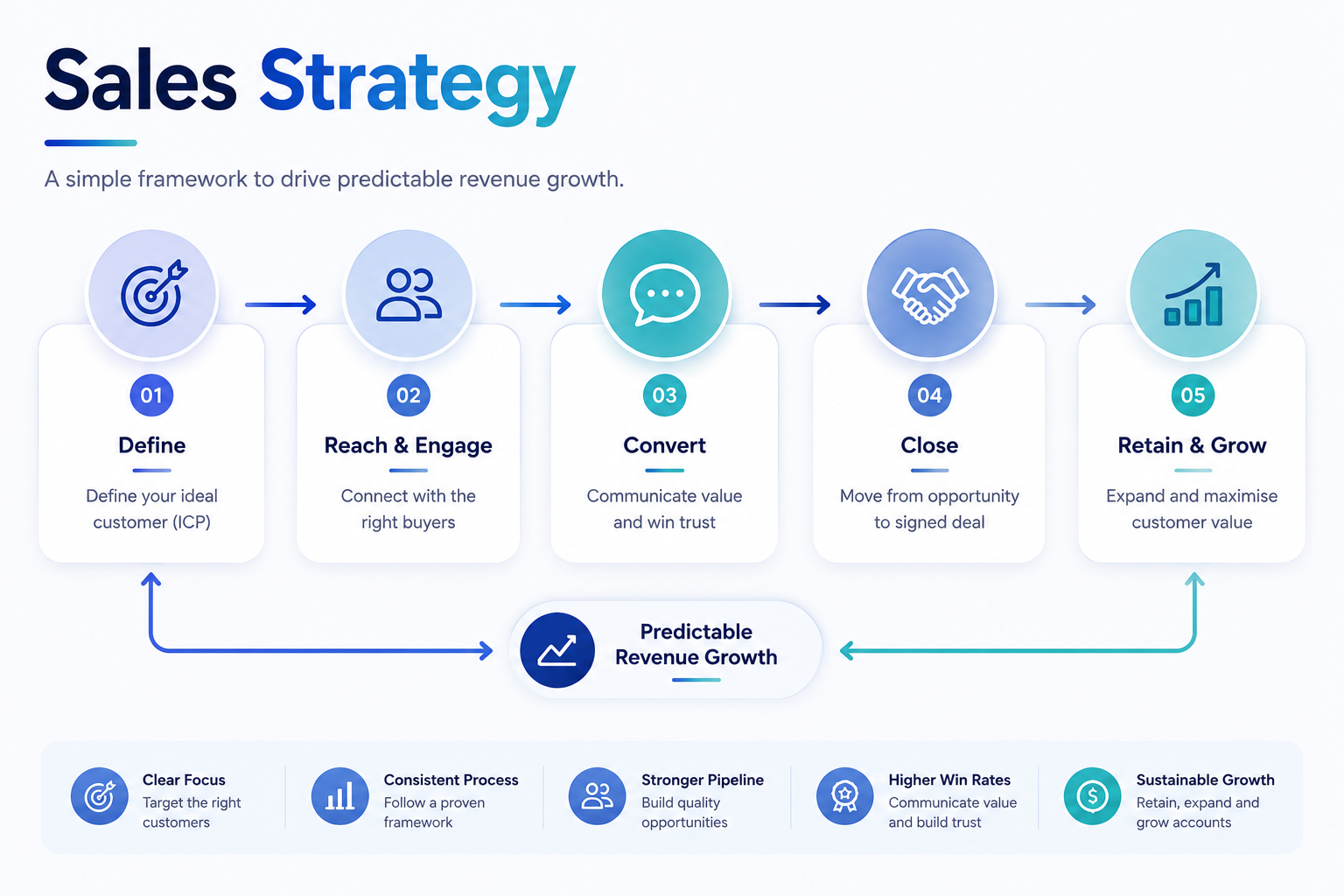
A winning sales strategy is the difference between a sales team that consistently hits quota and one that relies on heroic individual effort to make up for process gaps. This guide covers everything, from foundational definitions to advanced enterprise tactics, so revenue leaders, sales managers and individual contributors can build a strategy that compounds over time.
Whether you are constructing your first structured B2B sales process, scaling an enterprise sales strategy or searching for proven B2B sales techniques to improve close rates, this guide delivers the complete framework used by high performing revenue teams in 2026.
What Is a Sales Strategy?
A sales strategy is a long term plan that defines how a company will acquire customers, generate revenue and grow its book of business. It answers four core questions in sequence: Who is the ideal buyer? How do you reach and engage them? What do you say to convert them? And How do you retain and expand them after the initial sale?
A sales strategy is distinct from a sales plan, a sales playbook and a set of tactics. Understanding these distinctions prevents the most common strategic execution failure: confusing activity with direction.
| Concept | What It Is | Time Horizon | Who Owns It |
|---|---|---|---|
| Sales Strategy | Long term plan for winning the right customers | 12-36 months | CRO / VP Sales |
| Sales Plan | Quarterly or annual targets, territories, quotas | Quarterly / Annual | Sales Leadership |
| Sales Playbook | Documented plays, messaging and process by scenario | Ongoing / evergreen | Sales Enablement |
| Sales Tactics | Specific actions reps take to advance deals | Daily / weekly | Account Executives |
| B2B Sales Process | Stage by stage framework from lead to close | Per deal timeline | Sales Ops / Management |
The Core Components of a Sales Strategy
Every effective sales strategy contains these five foundational elements:
- Ideal Customer Profile (ICP): The precise definition of your highest value buyer, covering firmographic, technographic and behavioural attributes. Without a tight ICP, every other strategy element produces inconsistent results.
- Value Proposition and Positioning: The specific, differentiated outcome your product delivers to your ICP, substantiated by customer evidence, not marketing assertions.
- Sales Motion and Channel Mix: Whether you will use inbound, outbound, product led, partner led or a hybrid motion and which channels will carry each stage of the funnel.
- Sales Process and Methodology: A documented, stage gated process from first contact to closed deal, with clear entry and exit criteria at each stage.
- Metrics and Accountability Framework: The specific KPIs that define success at each funnel stage, with owners, reporting cadence and threshold values that trigger strategic review.
Growth is happening at most B2B organisations, but sustainable, repeatable performance is not. Only 26% of reps consistently hit quota even at organisations reporting revenue growth. This gap is almost always attributable to a missing or undocumented sales strategy, not to a lack of talent or effort. A documented strategy closes the gap between individual heroics and team level consistency.
The B2B Sales Process: A Stage by Stage Framework
The B2B sales process is a repeatable, documented sequence of stages that guides a prospect from first contact to signed contract and beyond. A well defined process creates forecast accuracy, gives managers a coaching framework, helps new reps ramp faster and eliminates the deal stage ambiguity that stalls pipeline reviews.
Unlike B2C, the B2B sales process involves multiple decision makers, longer evaluation timelines, formal procurement steps and organisational buying committees with competing priorities. Each stage must be designed to address this complexity.
The 7-Stage B2B Sales Process
Prospecting and Lead Generation
Identify and qualify potential accounts that match your ICP across inbound (SEO, content, paid) and outbound (cold email, LinkedIn, phone) channels. Define clear MQL criteria so marketing and sales share the same qualification language.
Lead Qualification (MQL to SQL)
Apply a qualification framework (BANT, MEDDIC or CHAMP) to determine whether the lead has the Budget, Authority, Need and Timeline to be a real opportunity. SQL criteria should be written, agreed by both sales and marketing and enforced in CRM.
Discovery and Needs Assessment
Conduct structured discovery calls to uncover the prospect’s true pain points, strategic objectives, buying committee structure, decision criteria and timeline. Use frameworks like SPIN or Challenger to move beyond surface level needs to the business outcomes that drive purchase decisions.
Solution Presentation and Demo
Present a tailored solution mapped directly to the pain points and objectives uncovered in discovery. Avoid generic product demos. Every demo should address the economic buyer’s ROI case, the technical evaluator’s integration questions and the end user’s workflow concerns.
Proposal and Business Case
Deliver a written proposal with a clear value proposition, ROI quantification, implementation timeline and commercial terms. In enterprise deals, the proposal is the document your champion uses to sell internally. Build it to win their internal approval process, not just to impress the contact you’re talking to.
Negotiation and Objection Handling
Navigate procurement, legal and financial review with a prepared negotiation strategy. Document the top 10 objections your team encounters and build scripted, evidence backed responses. Never concede price without a corresponding reduction in scope or commitment.
Close and Handoff
Obtain formal commitment, execute contract and execute a structured handoff to customer success with full deal context transferred. The close is not the end of the sale. It is the beginning of the customer relationship that drives renewal, expansion and referral revenue.
SMB vs. Enterprise: How the B2B Sales Process Differs
| Stage | SMB Sales Process | Enterprise Sales Process |
|---|---|---|
| Prospecting | High volume, shorter research cycle | Account based, deep research per account |
| Qualification | BANT style, often single call | MEDDIC, multi call, multi stakeholder |
| Discovery | 1-2 calls, one primary contact | 3-6 calls, 4-8 stakeholders mapped |
| Demo / Presentation | Standard product demo | Custom presentation per stakeholder role |
| Proposal | Template based, quick turnaround | Custom ROI model, executive sponsor required |
| Negotiation | Price focused, short | Procurement, legal, security, finance involved |
| Close cycle | 1-3 months | 6-24 months |
| Deal value | $1K-$50K ACV | $50K-$1M+ ACV |
Companies that continuously refine their B2B sales process eliminate inefficiencies, improve sales techniques and create a competitive edge. A defined process also creates reliable forecasting, enabling leaders to set realistic targets, allocate resources effectively and anticipate revenue fluctuations with far greater confidence than informal, rep dependent approaches.
Enterprise Sales Strategy: How to Win Complex, High Value B2B Deals
Enterprise sales strategy is a distinct discipline from SMB or mid market selling. Enterprise deals are characterised by larger contract values ($50K-$1M+ ACV), longer sales cycles (6-24 months), multiple decision makers (6-13+ stakeholders per deal) and formal procurement processes that require a strategic, relationship driven approach throughout.
The most successful enterprise sales teams in 2026 treat enterprise selling as a structured system, not a series of individual efforts. They control deal progression rather than waiting for buyers to move and they invest in multi threaded account relationships that survive stakeholder changes.
The Five Pillars of a Winning Enterprise Sales Strategy
ICP Precision
Focus exclusively on accounts that match your ICP at the enterprise level. An enterprise ICP includes industry vertical, company size, technology stack, buying trigger events (funding rounds, leadership changes, M&A activity) and compliance requirements. Chasing well known brand names that do not fit your ICP is the most common cause of 9-month sales cycles that end in no decision.
Buying Committee Mapping
Map all 6-13 stakeholders before the first executive meeting. Identify: the Economic Buyer (controls budget), the Champion (advocates internally), the Technical Evaluator (assesses integration and security), End Users (whose workflow changes) and Blockers (whose priorities your solution disrupts). Tailor every communication to each stakeholder’s specific success criteria.
Multi Threaded Relationship Building
Never rely on a single champion in an enterprise deal. Build relationships at every level of the buying committee simultaneously. Deals with only one internal advocate stall the moment that person changes role, goes on leave or is overruled by a stakeholder the rep has never engaged. Multi threading also prevents competitor coaches from neutralising your champion.
Consultative Value Creation
Enterprise buyers are not looking for vendors. They are looking for strategic partners who bring domain expertise, market intelligence and a point of view that helps them make better decisions. Replace standard product demos with workshops, ROI co creation sessions and executive briefings. Teach, do not pitch.
Deal Momentum Management
Long sales cycles die from inertia, not objection. Maintain momentum through consistent, high value touchpoints: executive business reviews, pilot programme design sessions, procurement pre work and competitor differentiation briefings. Set a mutual action plan (MAP) in writing with the champion at each stage, defining joint next steps, owners and dates. Deals without a MAP stall at every stage.
Enterprise Sales Qualification: The MEDDIC Framework
MEDDIC is the gold standard qualification framework for enterprise sales. It forces reps to answer six critical questions before investing significant time in any opportunity:
| Letter | Element | Key Question to Answer | Why It Matters |
|---|---|---|---|
| M | Metrics | What quantifiable business impact will our solution deliver? | Anchors ROI case; makes the business review compelling |
| E | Economic Buyer | Who has final budget authority? Have we met them? | Deals without EB access stall at contract stage |
| D | Decision Criteria | What are the specific criteria the buying committee will use? | Lets you align your pitch to what actually drives the decision |
| D | Decision Process | What are the steps and timeline to a signed contract? | Enables accurate forecasting and Mutual Action Plan |
| I | Identify Pain | What is the business pain driving urgency? How severe? | Severity of pain equals likelihood of status quo being disrupted |
| C | Champion | Who is advocating internally? Do they have the power and will to win? | Weak or untested champions are the most common forecast error |
B2B Sales Techniques: The Top Methodologies for 2026
The most effective B2B sales techniques in 2026 are structured methodologies that give reps a consistent framework for discovery, positioning and deal advancement. These are not scripts. They are thinking frameworks that improve the quality of every buyer conversation. High performing teams typically adopt one primary methodology and adapt it to their specific ACV range and buyer type.
SPIN Selling: Discovery Driven Technique
Best for: Complex B2B deals; mid market and enterprise; deals where buyers do not fully understand their own problem.
Developed by Neil Rackham from analysis of 35,000+ sales calls, SPIN Selling replaces traditional feature led pitching with a structured questioning framework that guides buyers to articulate their own pain and recognise the consequences of inaction.
The 4 SPIN Question Types
- Situation: Understand the current state, context and environment
- Problem: Uncover specific difficulties or dissatisfactions
- Implication: Explore the consequences of leaving the problem unsolved
- Need Payoff: Let the buyer articulate the value of the solution themselves
When SPIN Works Best
- High value deals where ROI must be clearly articulated
- Buyers who have not yet fully defined their requirements
- Situations where competitors are selling on features and price
- Discovery calls with technical evaluators who need to justify the purchase
The Challenger Sale: Insight Led Technique
Best for: Enterprise deals; commodity threatened categories; buyers who believe they already have the answer.
The Challenger methodology, developed by CEB (now Gartner), identifies that the best performing reps do not build rapport first. They teach, tailor and take control. Challenger reps lead with a provocative commercial insight that reframes how the buyer sees their business problem, positioning the seller as a strategic advisor rather than a vendor.
- Teach: Share a unique, data backed insight that challenges the buyer’s current thinking about their market or operations
- Tailor: Connect the insight specifically to the buyer’s business priorities and the economic buyer’s goals
- Take Control: Drive the conversation toward the decision with confidence and commercial assertiveness
Solution Selling: Problem to Outcome Technique
Best for: B2B deals where the buyer has a defined problem but no clear solution; strong ROI demonstration capability.
Solution selling focuses on diagnosing business problems and positioning the product as the specific resolution. Rather than leading with product features, reps lead with a question: what problem are you trying to solve? The solution is then presented as a direct answer to that specific need, with measurable outcome claims.
MEDDIC: Qualification as Technique
Best for: Enterprise sales; complex multi stakeholder deals; improving forecast accuracy.
MEDDIC functions as both a qualification framework and a selling technique. When used throughout the sales process, not just at initial qualification, it gives reps a complete map of the buying decision that competitors typically do not have. Teams trained on MEDDIC consistently outperform their peers on win rate and forecast accuracy.
Account Based Selling (ABS)
Best for: Enterprise and strategic accounts; long sales cycles; companies selling into a defined list of target accounts.
Account Based Selling treats each target account as a market of one. Instead of generic outreach, every touchpoint, including email, call, LinkedIn connection and event invitation, is hyper personalised to the specific account’s business context, strategic priorities and buying committee structure. ABS aligns sales and marketing around the same named accounts, eliminating the friction that leads to misaligned MQL to SQL handoffs.
| Methodology | Core Principle | Best Deal Size | Key Strength |
|---|---|---|---|
| SPIN Selling | Question led discovery that surfaces pain and consequence | Mid market to Enterprise | Forces buyers to self discover the need for change |
| Challenger Sale | Lead with a commercial insight that reframes buyer thinking | Enterprise | Differentiates in commodity markets; builds strategic partnership |
| Solution Selling | Map product to a specific, diagnosed business problem | SMB to Mid market | Simplifies complex value propositions into clear ROI outcomes |
| MEDDIC | Systematic qualification of all deal dimensions | Enterprise | Improves forecast accuracy; filters unwinnable deals early |
| Account Based Selling | Treat each target account as a unique market | Enterprise / Strategic | Aligns sales and marketing; improves conversion on high value accounts |
| SNAP Selling | Keep it Simple, valuable, iNvaluable, Priority aligned | SMB to Mid market | Works with busy, distracted B2B buyers who resist complexity |
How to Build a B2B Sales Strategy: The 8-Step Framework
Building an effective sales strategy is not a one time event. It is a living system that is defined, executed, measured and iterated. Follow these eight steps to construct a strategy that your entire revenue team can align behind and execute against consistently.
- Define and validate your Ideal Customer Profile (ICP): Build a three layer ICP covering firmographic attributes (industry, company size, revenue, geography, funding stage), technographic attributes (existing tools, integration requirements) and behavioural signals (buying triggers, intent data, pain patterns). Validate against your best 10-20 existing customers, not against assumptions.
- Conduct competitive and market analysis: Map your three primary competitors across messaging, pricing, channel strategy and target customer. Identify the specific areas where your solution is verifiably differentiated. Build battlecards for each primary competitor before the first sales call, not after you lose to them the first time.
- Develop positioning and a value proposition: Define the precise, differentiated outcome your product delivers to your ICP, stated in the language of business outcomes (revenue, cost savings, risk reduction, time saved), not product features. The value proposition must be verifiable with customer evidence and defensible against the most credible alternative.
- Select your primary sales motion: Choose between inbound (marketing driven lead generation), outbound (rep driven prospecting), product led (freemium or self serve trial), partner led (channel or reseller) or a hybrid of these. Your primary motion should be selected based on ACV, time to value and the ICP’s preferred buying behaviour, not on what competitors do.
- Document your sales process with stage gate criteria: Create a written, stage gated sales process with explicit entry and exit criteria for each stage. Every stage transition should be based on verified buyer action (a demo attended, a business case reviewed, a stakeholder introduced), not on a rep’s optimism about where the deal stands.
- Select and train your team on a primary methodology: Choose one primary methodology (SPIN, Challenger, MEDDIC or Solution Selling) and train your entire team to a standard of demonstrated competency, not attendance at a training session. Supplement with role specific skills: discovery call frameworks for SDRs, negotiation frameworks for AEs and expansion playbooks for AMs.
- Set KPIs and a measurement cadence: Define the specific metrics that will tell you whether your strategy is working: win rate by segment, average sales cycle length by deal size, pipeline coverage ratio, conversion rates at each stage and CAC by acquisition channel. Set reporting cadences (weekly pipeline reviews, monthly funnel reviews, quarterly strategy retrospectives) before the strategy launches.
- Build a feedback loop and iteration cycle: A sales strategy that is not reviewed and updated is a static document. Schedule quarterly win/loss reviews with real deal data, a semi annual ICP review and an annual full strategy retrospective. Assign a revenue operations owner to maintain the strategy document and ensure it reflects current market reality.
AI in B2B Sales Strategy: What Is Changing in 2026
Artificial intelligence is no longer a future consideration in B2B sales strategy. It is a present competitive requirement. McKinsey reports that companies investing in AI powered sales see 3-15% revenue uplift and 10-20% sales ROI uplift. The gap between AI augmented and traditional sales teams is now measurable in pipeline velocity, forecast accuracy and rep productivity.
AI Applications Already in Use
- Predictive lead scoring: AI models that score inbound leads based on fit, engagement signals and propensity to buy
- AI assisted outreach: Personalised email and LinkedIn sequences generated at scale, with human review and editing
- Deal risk monitoring: Real time alerts when deal velocity slows, stakeholder engagement drops or close date slips
- Intelligent forecasting: AI adjusted pipeline predictions that reduce human over optimism bias in quarterly reviews
- Conversation intelligence: AI analysis of call transcripts to identify winning talk tracks, objection patterns and coaching opportunities
What AI Does Not Replace
- Strategic account judgement: which accounts to pursue and why
- Consultative discovery: the quality of questions asked in a live conversation
- Relationship building: trust built through consistent, valuable human interaction
- Executive presence: the credibility an experienced rep brings to a C suite meeting
- Negotiation judgment: reading buyer signals and making real time commercial decisions
AI accelerates and augments the best reps. It does not replace the human judgment that closes enterprise deals.
B2B sales organisations that have not yet deployed AI for lead scoring, deal monitoring or conversation intelligence are operating with a structural disadvantage. Teams using agentic AI, systems that take action on insights rather than just surface them, report faster quota attainment, better forecast accuracy and higher rep retention. This is not a future investment: AI augmented competitors are already inside your accounts.
B2B Sales Metrics: What to Measure and When
A sales strategy without a measurement framework is a hypothesis. Track these KPIs across three categories to evaluate whether your strategy is working or needs to be iterated:
| Metric | Category | What It Measures | 2026 Benchmark |
|---|---|---|---|
| Win Rate | Revenue | Closed won / total qualified opportunities | Average: 21%; top performers: 35%+ |
| Sales Cycle Length | Efficiency | Average days from SQL to closed won | SMB: 1-3 mo; enterprise: 6-24 mo |
| Pipeline Coverage Ratio | Forecasting | Total pipeline value vs. revenue target | Enterprise: 3-5x target needed |
| MQL to SQL Conversion | Marketing Alignment | Qualified leads that become sales ready opportunities | B2B median: 13% |
| Stage Conversion Rate | Process Efficiency | Prospects advancing through each stage | Identify dropoff stages for coaching |
| Average Deal Size (ACV) | Revenue Quality | Mean annual contract value of closed deals | Should trend upward as ICP tightens |
| Customer Acquisition Cost (CAC) | Capital Efficiency | Total sales and marketing spend / new customers | Target: CAC payback 12-18 months |
| Quota Attainment Rate | Team Performance | % of reps hitting or exceeding quota | High performing teams: >70% of reps |
| Ramp Time to Quota | Team Efficiency | Months for new rep to reach full productivity | SMB: 3-5 mo; enterprise: 6-9 mo |
| Net Revenue Retention (NRR) | Revenue Quality | Revenue retained and expanded from existing accounts | Best in class B2B: >120% |
Benefits of Building a Documented Sales Strategy
A documented sales strategy is not a bureaucratic exercise. It is the primary driver of revenue consistency, team efficiency and competitive advantage. These are the measurable organisational benefits that accrue when strategy is treated as an operating system, not a planning document:
Consistent Revenue Performance
Documented processes give every rep a repeatable path to follow, reducing reliance on individual heroics. Organisations with a written sales strategy consistently report higher quota attainment across the team, not just from top performers.
Faster Rep Ramp Time
New reps onboarded into a documented process with clear stage criteria, methodology training and written playbooks ramp 40-60% faster than those learning by trial and error in undocumented environments. Strategy clarity is a talent multiplier.
Better Forecast Accuracy
Stage gate criteria and consistent qualification frameworks (MEDDIC, BANT) eliminate the optimism bias that inflates pipeline reviews. Teams with documented entry criteria at each stage forecast 30-40% more accurately than teams without them.
Shorter Sales Cycles
Precise ICP targeting removes misfit prospects from pipeline early and structured discovery processes accelerate stakeholder alignment. A focused B2B sales strategy with tight ICP criteria typically reduces average cycle length by 20-35% within two quarters of implementation.
Higher Average Deal Size
Consultative techniques (Challenger, SPIN) and solution selling frameworks that focus on business outcome ROI consistently produce larger initial contract values than feature led presentations. Teams trained on these methodologies report 15-25% higher ACV in controlled comparisons.
Lower Customer Acquisition Cost
Channel concentration guided by ICP precision, rather than spray and pray prospecting, produces lower CAC. Organisations that define their ICP tightly before scaling outbound or paid channels consistently report 30-50% lower blended CAC versus undirected approaches.
Stronger Sales and Marketing Alignment
A shared ICP definition, agreed MQL to SQL criteria and documented pipeline attribution resolve the most common revenue team conflict. When sales and marketing agree on who a qualified buyer is, conversion rates at every funnel stage improve.
Investor Credible Revenue Model
A documented sales strategy with validated unit economics, including win rates, cycle lengths, CAC and NRR by segment, transforms a revenue narrative from aspirational to evidential. Investors and boards fund repeatable systems; a documented strategy is proof that one exists.
Frequently Asked Questions
A sales strategy is a long term plan that defines how a company acquires customers, generates revenue and grows its book of business. It covers ICP definition, value proposition, sales motion, channel selection, process design, methodology and the metrics used to evaluate performance. A sales strategy is distinct from a sales plan (quarterly targets and quotas), a sales playbook (scenario specific plays) and a set of tactics (individual rep actions).
A B2B sales process is a documented, repeatable sequence of stages that guides a prospect from first contact to signed contract. Typical stages include: prospecting, lead qualification (MQL to SQL), discovery, presentation, proposal, negotiation and close. Each stage has defined entry and exit criteria. A documented B2B sales process creates forecast predictability, enables consistent coaching, accelerates rep ramp and eliminates the deal stage ambiguity that produces inaccurate pipeline reviews.
The most effective B2B sales techniques in 2026 are: (1) SPIN Selling, which uses question led discovery to surface pain and consequence; (2) Challenger Sale, an insight led approach that reframes buyer thinking; (3) MEDDIC, a qualification framework that filters unwinnable deals and improves forecast accuracy; (4) Solution Selling, which maps the product to diagnosed business problems; and (5) Account Based Selling, which treats each target account as a unique market with personalised outreach. The best technique for any team depends on ACV range, buyer type and sales cycle length.
Build a B2B sales strategy in eight steps: (1) Define and validate your ICP across three layers; (2) Conduct competitive analysis and build battlecards; (3) Develop a differentiated value proposition backed by customer evidence; (4) Select your primary sales motion (inbound, outbound, PLG, partner led); (5) Document your sales process with stage gate criteria; (6) Select and train your team on a primary methodology; (7) Set KPIs and a measurement cadence across win rate, cycle length, pipeline coverage and conversion; (8) Build a quarterly feedback loop and iteration cycle. Review and update the strategy quarterly to reflect market reality.
AI is transforming B2B sales across four dimensions: (1) Predictive lead scoring, with AI models that rank prospects by propensity to buy based on behavioural and firmographic signals; (2) AI assisted outreach, with personalised sequences generated at scale with human review; (3) Deal risk monitoring, with real time alerts when deal velocity drops or engagement signals weaken; (4) Intelligent forecasting, with AI adjusted pipeline predictions that correct for human over optimism. McKinsey data shows 3-15% revenue uplift for companies using AI in sales. Teams without AI augmented sales infrastructure are at a measurable competitive disadvantage in 2026.