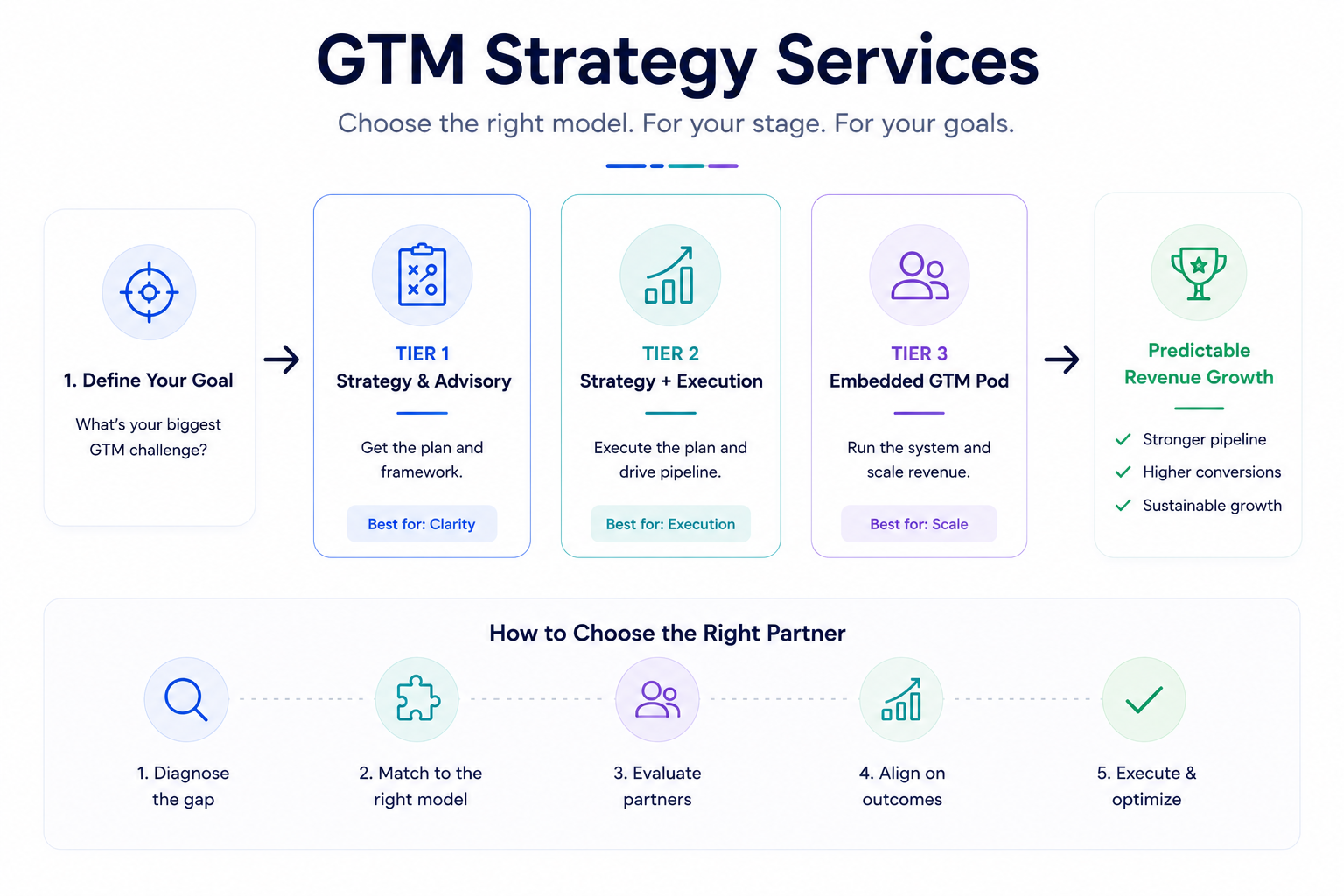
What GTM Strategy Services Actually Include
The term GTM strategy services is used to describe anything from a two-week positioning workshop to a 12-month embedded revenue operation. Before comparing vendors, establish what category of service you actually need: the deliverables differ entirely.
Strategy & Advisory
ICP definition, positioning framework, motion selection, pricing validation, channel prioritization, and documented GTM plan. Delivered as a consulting engagement, no execution ownership.
Strategy + Execution
Everything in Tier 1, plus active channel operations: outbound sequencing, content creation, paid media management, CRM configuration, and pipeline reporting on a retainer basis.
Embedded GTM Pod
Cross-functional team embedded in your org: outbound pod, RevOps pod, CS infrastructure, and AI automation, operated as a connected revenue system until pipeline is self-sustaining.
| Service Component | Tier 1 Advisory | Tier 2 Agency | Tier 3 Embedded Pod |
|---|---|---|---|
| ICP definition & validation | ✓ | ✓ | ✓ |
| Positioning & messaging | ✓ | ✓ | ✓ |
| PLG/SLG motion selection | ✓ | ✓ | ✓ |
| Channel strategy & prioritization | ✓ | ✓ | ✓ |
| Outbound sequence execution | Not included | ✓ | ✓ |
| CRM / RevOps build & operation | Not included | Partial | ✓ |
| Content & SEO/GEO execution | Not included | ✓ | ✓ |
| Pipeline reporting & attribution | Not included | Partial | ✓ |
| Ongoing optimization cadence | Not included | ✓ | ✓ |
The most common mistake: Hiring a Tier 1 advisory firm when you need Tier 2 execution. A 60-slide strategy deck with a 90-day roadmap is expensive documentation, not a revenue system. If your team lacks the bandwidth to execute the plan internally, you need an agency or pod, not a consultant.
Go-to-Market Agency Models: Which One Fits Your Stage?
There is no single type of go-to-market strategy agency. The market segments into four distinct operating models, each optimized for a different stage, ACV, and internal capability level. Matching model to stage is more important than matching brand to budget.
Big 4 & Global Strategy
$50K–$500K+ · McKinsey, Bain, BCG, PwC, Accenture. Best for enterprise market entry, regulatory-heavy sectors, and board-level credibility requirements.
Specialist Boutique Agency
$8K–$25K/mo · SaaS/B2B-native, motion-specific. Seed to Series B. PLG, SLG, or hybrid motions with execution + advisory blend and channel-specific depth.
Fractional GTM Leader
$5K–$15K/mo · Ex-CMO or ex-VP Sales, part-time embed. Pre-seed to Series A. Strategic ownership without headcount, best when your team can execute.
Embedded GTM Pod
$15K–$40K/mo · Cross-functional team embedded in your org. Series A–C. Outbound + RevOps + CS + AI. Operates until pipeline self-sustains with highest execution depth.
Strategy + assigned channel execution
- ICP, positioning, motion, full strategy layer
- Executes assigned channels (content, paid, outbound)
- Ideal stage: Seed → Series B
Full system architecture + all pods
- Full strategy + system architecture across all GTM functions
- Runs all pods: outbound, RevOps, CS, AI automation
- Ideal stage: Series A → Series C
Stage mismatch warning: A fractional leader is powerful when your team can run the plays. An embedded pod is the right call when you need someone to build and operate the system simultaneously. Confusing the two is the single most expensive hiring mistake in GTM services.
When to Outsource GTM Strategy and When Not To
Deciding to outsource GTM strategy is a make-or-buy decision with asymmetric risk. Get it right and you compress months of channel experimentation into weeks. Get it wrong and you’ve paid for a deck your team can’t execute and lost six months of runway.
These signals mean outsourcing will work
- Pre-PMF: You need to compress ICP validation, specialists have seen 50 versions of this problem
- New market entry: Entering a segment where your team has no existing motion or relationships
- No GTM headcount: ACV doesn’t justify a full-time VP Marketing or Head of Sales
- Stalled pipeline: You have a product and willing buyers but conversion rates are broken
- Speed imperative: Competitive window is closing and building in-house is structurally slower
These signals mean outsourcing will fail
- No internal champion: No one internally to absorb and sustain the work after the engagement
- Product isn’t ready: A GTM firm cannot fix a product that doesn’t solve a real problem
- Misaligned expectations: Leadership expects leads in week two of a strategy engagement
- Budget for strategy but not execution: Produces expensive documentation, not revenue
The compounding point: Most GTM agency partnerships don’t produce compounding pipeline until months 6–9 of consistent execution. If you’re planning a 90-day engagement expecting full-scale results, reset the timeline, or you’ll churn the relationship before the curve bends.
What Is a GTM Advisory Firm and Do You Need One?
A GTM advisory firm sits at the strategic layer: it provides counsel, frameworks, and senior expertise without directly operating pipeline. Think of it as a board-level function embedded at the GTM level, high-signal, low-bandwidth. Advisory engagements are typically project-scoped (6–12 weeks), not retainer-based.
Strategic outputs
- Market sizing and segmentation analysis
- ICP hypothesis validation via structured discovery
- Sales motion selection (PLG, SLG, hybrid)
- Positioning architecture and messaging brief
- Channel prioritization and budget allocation framework
- Metrics and KPI definition for the first 90 days
Execution outputs
- Active pipeline management
- Outbound sequence writing and operation
- CRM configuration and daily management
- Content production and SEO execution
- Weekly channel optimization and reporting dashboards
How to Evaluate a Go-to-Market Strategy Agency
When shortlisting a go-to-market strategy agency, most buyers evaluate on brand recognition and case studies. Both matter, but they are not the primary filter. Stage fit, motion expertise, and execution depth are the three variables that predict outcome.
| Criterion | What to Ask | Red Flag Answer | Weight |
|---|---|---|---|
| Stage Fit | What is the ARR range of companies you typically work with? | “We work with companies of all sizes” | High |
| Motion Expertise | Do you specialize in PLG, SLG, or hybrid? Show me a case study for each. | “We do all motions” without vertical proof | High |
| Execution Depth | Who on your team will actually run our outbound / content / RevOps? | The strategist pitching you won’t be your day-to-day contact | High |
| Sector Experience | Do you know our buyer’s procurement process and decision timeline? | Generic answers about “B2B buyers” without vertical specifics | Medium |
| Success Definition | How do you define success at 30, 90, and 180 days? What metrics do you own? | Vague outputs (“strategy deck”) without pipeline KPIs | High |
| AI & GEO Capability | How do you structure content for AI-assisted discovery and generative search? | No answer, or “we focus on SEO” without GEO mention | Medium |
⚠ The Bait-and-Switch Pattern: Senior partners pitch the engagement, junior analysts deliver the work. Always ask who will be your primary point of contact, and get it in the contract. The person presenting in the sales call should be the one running your GTM motion.
Questions to Ask on the First Call
- Reference check: “Can I speak to a client at a similar ARR stage who used this service in the last 12 months?”
- Failure post-mortem: “Tell me about an engagement that didn’t work and why.” (How they answer tells you more than any case study.)
- Deliverable specificity: “What exactly does week 1, month 1, and month 3 look like for a client in our situation?”
- Offboarding plan: “What does knowledge transfer look like at the end of engagement? What do we own?”
- Conflict of interest: “Are you currently working with any direct competitors? What’s your conflict policy?”
Benefits of GTM Strategy Services
A well-matched GTM strategy service doesn’t just deliver a plan, it compresses timelines, reduces wasted spend, and builds durable infrastructure that compounds after the engagement ends.
Compressed Time-to-Pipeline
Specialist agencies have run ICP validation, channel testing, and messaging iteration for dozens of similar companies. What takes an in-house team 9–12 months compresses to 3–5 months with pattern-matched expertise from day one.
Lower Blended CAC
GTM services that specialize in ICP precision and channel concentration consistently produce 30–50% lower CAC within the first year. Agencies that own attribution show you exactly which channel dollar is working.
Durable Revenue Infrastructure
Embedded pod engagements leave behind a functioning revenue system: CRM architecture, outbound playbooks, attribution dashboards, and onboarding workflows, not just recommendations.
De-Risked Market Entry
For companies entering new segments, geographies, or buyer personas, GTM advisory firms provide validated frameworks based on comparable launches, avoiding the most expensive category of GTM mistake.
Investor-Ready GTM Narrative
A documented GTM strategy with validated unit economics: CAC by channel, LTV:CAC ratios, and payback periods directly strengthens Series A–B positioning. Investors fund repeatable systems.
Faster Internal Hiring
A working GTM playbook built by an agency gives new hires a documented system to ramp against. AEs and marketers onboarded into a structured motion ramp 40–60% faster than those learning by trial-and-error.
GTM Strategy Services Pricing: What to Budget by Model
Pricing for GTM strategy services varies by engagement model, agency tier, and scope. The ranges below reflect 2026 market rates across the four primary models.
| Model | Typical Range | Engagement Type | Best For |
|---|---|---|---|
| Big 4 / Global Strategy | $50K–$500K+ | Project-based | Enterprise, regulatory, board-level |
| Specialist Boutique Agency | $8K–$25K/month | Retainer (6–18 mo) | Series A–C SaaS growth |
| Project-Based GTM Strategy | $30K–$80K | Fixed scope (6–12 wks) | Pre-launch, new market entry |
| Fractional GTM Leader | $5K–$15K/month | Part-time retainer | Pre-seed to Series A |
| Embedded GTM Pod | $15K–$40K/month | Quarterly renewable | Series A–C, full-stack execution |
Value concentration insight: Most growth-stage SaaS companies ($1M–$10M ARR) find 80% of the value at the $10K–$20K/month boutique agency tier. Big 4 pricing is justified by regulatory complexity, global scope, and board signaling, not by GTM execution quality for venture-backed software companies.
2026 GTM Services: What Has Changed
The GTM services market has shifted materially in 2026. Three structural changes affect how you evaluate and select a partner, and which agencies are already behind.
AI-Powered Discovery is a Primary Channel
AI search now rivals Google for enterprise software discovery. GTM agencies that don’t offer Generative Engine Optimization (GEO), structured content for AI retrieval, are operating with a 2023 channel playbook. Ask specifically about GEO before signing.
Single-Channel Outbound is Dead
Top-performing GTM teams now orchestrate LinkedIn, email, phone, and paid with precision sequencing. Any agency still pitching “cold email at scale” as a primary motion is behind the curve. Omnichannel is the baseline, not the premium tier.
NRR Over Acquisition
Investors in 2026 weight Net Revenue Retention above new logo acquisition. The best GTM services now include an explicit expansion motion: account-based upsell, customer success architecture, and expansion MRR playbooks, not just top-of-funnel acquisition.