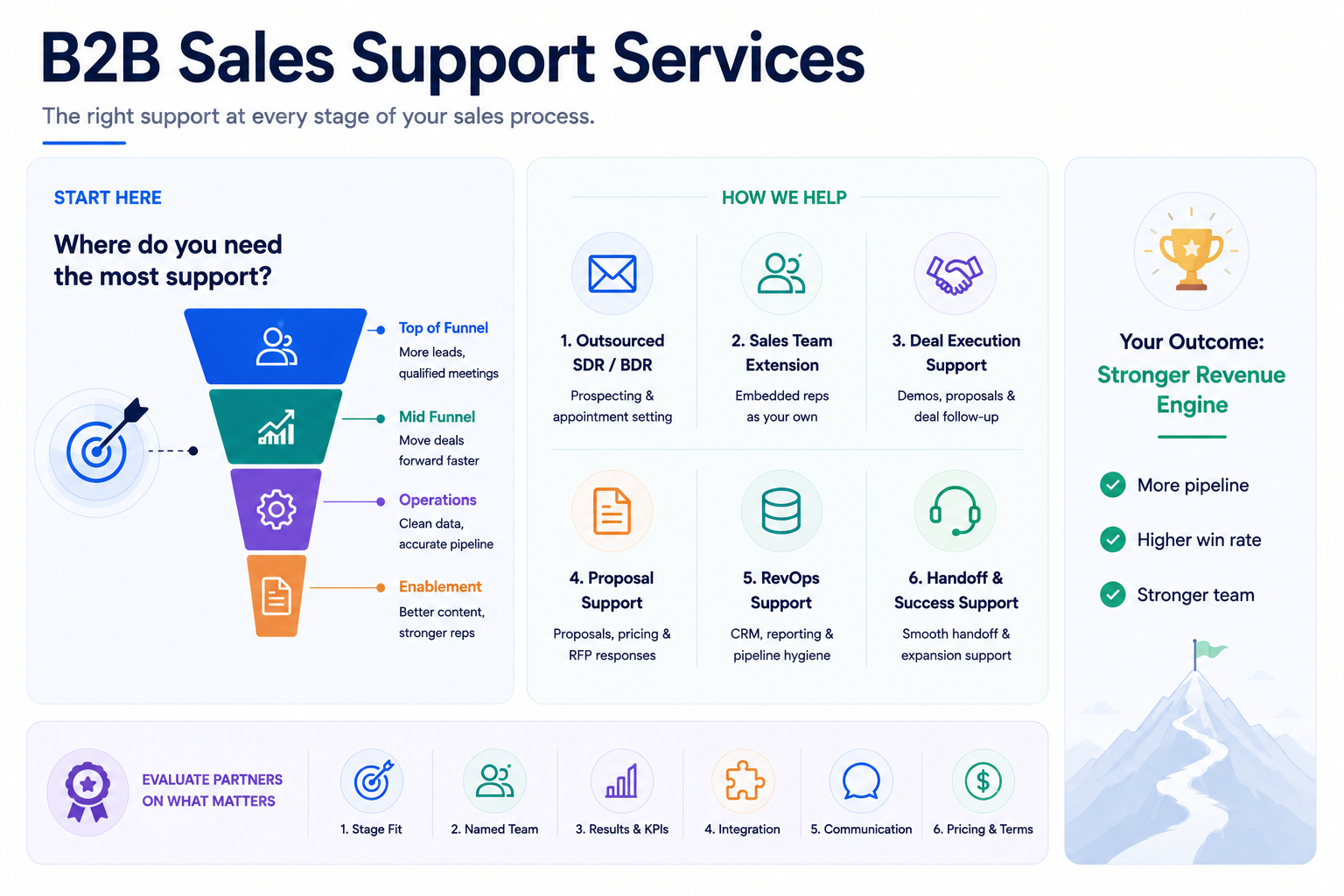
- B2B sales support services is a broad category: it spans SDR outsourcing, sales team extension, full-cycle sales execution, pipeline support, CRM operations and sales enablement. Know which you need before comparing vendors.
- The critical BOFU question: Are you buying pipeline volume (top-of-funnel support), deal velocity (mid-funnel execution support) or revenue infrastructure (RevOps + enablement)? Each requires a different provider type.
- Sales team extension is the highest-trust model: an external team that operates, reports and communicates as if they were your own reps. This requires the deepest integration and the most thorough vetting.
- Sales support outsourcing makes economic sense when: pipeline is inconsistent, headcount is constrained, you are entering a new market or your AEs are spending too much time on top-of-funnel activity.
- B2B sales execution support covers the full spectrum from SDR sequences through proposal support, CRM hygiene and post-meeting follow-up. The best providers extend your team across multiple execution layers simultaneously.
- 2026 pricing benchmarks: shared SDR $3K–$7K/month; dedicated SDR $6K–$12K/month; full execution pod $8K–$25K/month; sales enablement support $3K–$10K/month; RevOps as a service $4K–$12K/month.
- Top evaluation criteria: named team commitment, pipeline-level KPIs (not activity metrics), stage-fit evidence, sector expertise and CRM/tech stack integration depth.
- Time-to-results: outsourced SDR meetings in 30–60 days; pipeline lift from execution support in 60–90 days; compounding revenue impact from full-model engagement at 4–6 months.
What Are B2B Sales Support Services?
B2B sales support services are externally delivered capabilities that augment, extend or operate specific elements of a business’s sales function. Unlike pure consulting (which delivers strategy and frameworks), sales support services are execution-oriented: external teams and systems that actively work in your pipeline, CRM and outreach channels alongside or in place of internal resources.
The category is broader than most buyers initially expect. It spans everything from outbound SDR prospecting and appointment setting, to sales enablement content production, CRM hygiene and RevOps operations, proposal support, post-demo follow-up management and full-cycle sales team extension. Understanding exactly which layer of the sales function you need supported is the most important pre-purchase decision in this category.
The Four Sales Support Layers
Most B2B companies need support at one or more of these four distinct layers. Identify your primary gap before evaluating any provider:
| Layer | What It Covers | Key Gap It Solves | Provider Type |
|---|---|---|---|
| 1. Top-of-Funnel Support | Prospecting, list building, outbound sequences, appointment setting | Pipeline volume is low; AEs don’t have enough meetings | Outsourced SDR / BDR firm |
| 2. Mid-Funnel Execution | Demo prep, proposal support, follow-up sequences, deal progression | Deals stall after demo; AEs lose momentum in long cycles | Sales execution support firm |
| 3. Revenue Operations | CRM hygiene, pipeline reporting, attribution, tech stack management | Forecast accuracy is poor; sales data is unreliable | RevOps as a Service provider |
| 4. Sales Enablement | Content creation, battlecards, playbooks, training, onboarding | Reps ramp slowly; messaging is inconsistent across the team | Sales enablement partner |
The BOFU Buyer’s Single Most Important Question
Before comparing any providers, answer this: “Is our primary revenue gap in pipeline volume (not enough leads and meetings), conversion rate (deals stalling or losing to competitors) or operational efficiency (our reps spend too much time on admin and not enough on selling)?” The answer determines which provider category you actually need. Buying the wrong layer of support is the fastest way to spend $10K/month and produce zero impact.
B2B Sales Support Services: What Providers Actually Deliver
A well-matched B2B sales support services provider covers one or more of these eight core service areas. Map each to the gap you identified before evaluating any vendor:
Outsourced SDR / BDR Services
Top-of-funnel pipeline generation. ICP-matched prospecting, multi-channel outreach (email, LinkedIn, phone), objection handling, qualified meeting booking to AE calendars, weekly pipeline reporting and CRM-integrated campaign tracking.
Appointment Setting & Lead Qualification
Converting inbound and outbound interest into booked meetings. Inbound lead response, outbound appointment setting campaigns, meeting confirmation, lead scoring, ICP-fit validation and calendar management across time zones.
Sales Team Extension
Embedded external reps operating as your own team. Dedicated reps aligned to your brand, CRM access within your systems, weekly standup integration, brand-consistent messaging, full-cycle support from first contact to close and playbook documentation.
B2B Sales Execution Support
Hands-on deal progression across all pipeline stages. Post-demo follow-up sequences, proposal and business case preparation, stakeholder mapping, competitive intelligence, deal risk monitoring and mutual action plan (MAP) creation and maintenance.
Revenue Operations as a Service
Pipeline infrastructure and performance analytics. CRM configuration and data hygiene, pipeline reporting and attribution dashboards, lead routing and lifecycle automation, sales KPI framework setup, tech stack audit and quarterly RevOps health reviews.
Sales Enablement Support
Content, training and onboarding to accelerate rep performance. Sales playbook creation, battlecards and competitive differentiation content, discovery and demo script frameworks, objection handling matrices and methodology training (SPIN, MEDDIC, Challenger).
Account-Based Sales Support (ABM)
Hyper-targeted support for named account programmes. Target account list curation, personalised outreach content per account, intent data monitoring, trigger-based outreach, multi-stakeholder engagement coordination and executive access programmes.
Channel & Partner Sales Support
Enabling resellers, partners and channel networks. Partner onboarding and enablement content, co-selling support, joint account planning, channel pipeline management, partner training and certification and market development fund (MDF) programme support.
Sales Support Outsourcing: Models, Costs and When to Engage
Sales support outsourcing converts fixed internal sales costs into variable, scalable resources. But the model you choose determines whether you get qualified pipeline or a flood of activity reports. The four outsourcing structures below cover the full spectrum from narrow channel execution to full sales department extension.
Shared SDR Model
Your account is managed by SDRs who also work for other non-competing clients. Lower cost but less dedicated attention. Best for: early-stage companies needing pipeline injection before they can justify a dedicated team. Cost: $3K-$7K/month. Meeting delivery: typically 5-15 qualified meetings per month depending on ICP and market.
Dedicated SDR Model
One or more SDRs work exclusively on your account, building deep ICP knowledge and consistent outreach. Higher cost, substantially better meeting quality. Best for: Series A-B companies needing consistent, high-quality pipeline without the 3-6 month hiring ramp. Cost: $6K-$12K/month per SDR. Meeting delivery: 15-40 qualified meetings per month.
Full Sales Pod (SDR + AE + Manager)
A complete external sales team – SDRs generating pipeline, AEs running discovery and demos and a sales manager overseeing the team. Operates as a fully external revenue function. Best for: new market entry, product line launches or companies without an internal sales infrastructure. Cost: $8K-$30K/month depending on team size.
Sales Augmentation (Team Extension)
External sales professionals embedded into your existing team – joining your Slack, using your CRM, attending your pipeline reviews. The highest-trust, highest-integration model. Best for: companies with strong internal leadership who need additional execution capacity or specialist skills without adding permanent headcount. Cost: $8K-$25K/month.
Build vs. Outsource Decision Matrix
| Decision Dimension | Outsource to Support Provider | Build In-House |
|---|---|---|
| Pipeline consistency | Inconsistent; need immediate activation | Stable pipeline; optimising conversion |
| Company stage | Seed – Series B; headcount constrained | Series B+; proven motion, need institutional depth |
| Time to first pipeline | Need meetings in 30-60 days | Investing in 6-12 month talent build |
| Internal sales management | No experienced SDR manager available | Strong sales manager to coach and direct |
| Market familiarity | Entering new vertical or geography | Established market with team that knows buyers |
| Budget model preference | Variable cost; scale up/down flexibility | Fixed headcount for compounding institutional knowledge |
| Brand sensitivity | Mid-high – requires dedicated team | Full control over brand representation |
The Activity Trap in Sales Support Outsourcing
The most common failure in sales support outsourcing: providers deliver detailed reports on calls made, emails sent and LinkedIn connections accepted – while pipeline remains empty. Require pipeline-level KPIs at contract stage: qualified meetings held, SQLs generated and pipeline value created. Any provider who resists accountable outcomes metrics is managing expectations of failure before the engagement begins.
Sales Team Extension: What It Means and What to Demand
The sales team extension model is the highest-integration form of B2B sales support. Unlike a traditional outsourcing engagement where an external team operates separately and reports monthly, a true sales team extension embeds external reps directly into your organisation – using your CRM, attending your pipeline reviews, communicating through your internal channels and representing your brand as if they were your own employees.
When done correctly, buyers and prospects cannot distinguish an extended team member from an internal one. When done poorly, it produces a third-party telemarketing feel that damages brand credibility and destroys deal momentum. The quality of integration determines which outcome you get.
The Five Non-Negotiables of True Sales Team Extension
- CRM access and data ownership: Extended team members work inside your CRM – not a parallel system you cannot see or export
- Internal communication channels: Slack, Teams or equivalent – real-time access to your internal team for deal context and escalation
- Pipeline review attendance: Weekly or bi-weekly participation in your sales cadence calls, not separate reporting calls
- Brand voice and messaging alignment: Deep discovery session on tone, values and buyer language before any prospect interaction
- Named, dedicated reps: The same person on your account every week – no rotating resources based on provider availability
- Works in a separate CRM system; sends you a monthly export
- No access to your internal communication tools
- Separate reporting call once a month instead of integrated cadence
- Uses generic templates; cannot articulate your ICP in their own words
- Rotating team members; no named individual committed to your account
Ask every candidate provider: “How does your team join our pipeline reviews?” If they cannot answer, they are not a true team extension.
Sales Team Extension vs. Outsourcing vs. Augmentation: The Differences
| Dimension | Standard Outsourcing | Sales Team Extension | Internal Augmentation |
|---|---|---|---|
| Integration depth | Operates externally; monthly reporting | Embedded in your tools, cadence and brand | Fully internal; own team headcount |
| CRM access | Parallel system or limited view | Full access to your CRM; operates inside it | Full access by definition |
| Communication | Account manager; weekly or monthly call | Slack/Teams + pipeline review attendance | Direct internal communication |
| Brand alignment | Generic; represents multiple clients | Deep brand voice training; acts as your own | Fully aligned; internal culture |
| Ramp time | 2-4 weeks to first outreach | 3-6 weeks for full integration | 3-6 months to hire and ramp |
| Cost | $3K-$12K/month | $8K-$25K/month | $12K-$20K/month fully loaded |
| Best for | Volume pipeline injection | High-trust, brand-sensitive execution | Long-term institutional knowledge |
B2B Sales Execution Support: Beyond Top-of-Funnel
Most buyers searching for B2B sales execution support are focused exclusively on top-of-funnel – more meetings, more pipeline. But the highest-leverage support opportunities are often in the mid-funnel and operational layers, where deals stall and AE time is wasted on activities that a support provider could own more efficiently.
Covers the Gap Between First Meeting and Signed Contract
Where 40-60% of qualified B2B pipeline is lost to no decision.
- Post-demo follow-up: Structured nurture sequences that maintain momentum after every demo
- Business case support: ROI calculation templates and proposal content your champion can use internally
- Stakeholder mapping: Identifying and engaging all 6-13 buying committee members proactively
- Competitive displacement: Real-time battlecard updates and competitive positioning as deals advance
- Deal risk monitoring: Alerts when engagement signals drop or deal velocity slows
The Infrastructure That Makes Every Sales Investment More Effective
Less dependent on individual rep memory – more driven by reliable data and automation.
- CRM hygiene and data accuracy: Clean pipeline data that managers and forecasters can trust
- Attribution and reporting: Multi-touch attribution models that show which channels produce which revenue
- Lead flow and routing: Automation that ensures every lead reaches the right rep at the right speed
- Sales analytics dashboards: Win rate, cycle length, stage conversion and CAC visible in real time
- Tech stack optimisation: Ensuring your CRM, SEP, intent tools and analytics platforms work as an integrated system
2026 Execution Gap Reality Check
SPOTIO’s 2026 State of B2B Field Sales survey found that the average B2B rep spends only 26% of their week on prospecting, selling and follow-up. The remaining 74% goes to admin tasks, CRM entry, research, internal meetings and non-revenue activities. B2B sales execution support addresses the most expensive problem in enterprise sales: highly compensated AEs and BDRs spending the majority of their time on work that a support provider could handle at a fraction of the cost.
How to Evaluate B2B Sales Support Services: The 5-Criterion Framework
When you are at the decision stage for B2B sales support services, evaluating on price and portfolio logos is a shortcut that produces expensive mismatches. Evaluate every provider against these five criteria – in this order – before any commercial conversation.
| Criterion | What to Evaluate | Red Flag Answer | Weight |
|---|---|---|---|
| 1. Stage and Vertical Fit | Have they worked with companies at your exact ARR stage and in your specific vertical? | “We work with all company sizes across every industry” | Critical |
| 2. Pipeline-Level KPIs | Do they commit to qualified meetings, SQLs and pipeline value – not just activity? | Reports on calls and emails sent; no outcome metrics | Critical |
| 3. Named Team Commitment | Can they name who will work on your account and for how many hours per week? | “You’ll have access to our team” without named individuals | High |
| 4. Integration Depth | How do they integrate with your CRM, tools and sales cadence? What do you own at exit? | Operates a separate system; no CRM access; no IP transfer on exit | High |
| 5. Reference Evidence | Can they provide a reference client at your stage, in your vertical, with measurable results? | Generic testimonials; no client willing to speak on record | High |
10 Questions to Ask Every Provider Before Signing
- “What is your average cost-per-qualified-meeting across your last 20 clients?” This single question separates pipeline-accountable providers from activity-accountable ones.
- “Who specifically will work on our account?” Get a name, a LinkedIn profile and a commitment on weekly hours before the contract is signed.
- “Walk me through what happens in weeks 1 through 4 of our engagement.” Vague answers at the onboarding question predict vague execution at every subsequent stage.
- “How do you integrate with our CRM?” Full access, working inside your system, is the standard for true team extension. Parallel systems are a red flag.
- “What do we own at the end of the engagement?” Contact data, sequence templates, playbooks and CRM configurations should be fully owned by you from day one.
- “Describe an engagement that failed to produce results and why.” How a provider talks about failure tells you more about accountability than any case study.
- “What is your average meeting-to-opportunity conversion rate?” Meeting volume without opportunity conversion is a vanity metric. Ask for this ratio across recent clients.
- “How do you handle our ICP validation?” Any provider that does not confirm ICP before deploying outreach volume is about to spend your budget on the wrong audience.
- “Are you currently working with direct competitors?” Ask for their conflict policy in writing. Shared learnings across direct competitors is a real risk in this category.
- “What’s your termination policy if KPIs are missed?” Providers confident in their results offer performance guarantees or short exit windows. Providers who resist are signalling risk.
Stage-Based Decision Matrix: Which Model Fits You?
| Your Situation | Recommended Model | Primary Signal |
|---|---|---|
| Founder-led; first outbound motion | Shared SDR outsourcing | Validate ICP and messaging before scaling |
| Seed-Series A; no SDR team | Dedicated SDR outsourcing | Consistent pipeline; can’t justify full hire yet |
| Series A; AEs lack top-of-funnel coverage | Sales team extension (SDR layer) | AEs strong at closing; need qualified meetings |
| Series A-B; deals stalling after demo | B2B sales execution support (mid-funnel) | Conversion gap, not pipeline gap |
| Series B; CRM data unreliable; forecasting weak | RevOps as a Service | Operational efficiency gap, not pipeline gap |
| Series B+; entering new vertical | Full sales pod (SDR + AE) | New market needs full-cycle execution without internal hire |
| Enterprise; need ABM coverage on named accounts | Account-based sales support | High-value accounts need personalised multi-threading |
B2B Sales Support Services: 2026 Pricing Guide
These are verified 2026 US market rate ranges across all major B2B sales support service models. Use them to sanity-check proposals before any negotiation.
| Service Model | Monthly Cost | Alt. Pricing | Contract Term | Best Stage |
|---|---|---|---|---|
| Shared SDR outsourcing | $3K-$7K/month | $250-$500/qualified meeting | 3-6 months | Seed; pipeline validation |
| Dedicated SDR (1 rep) | $6K-$12K/month | $150-$400/qualified meeting | 6-12 months | Series A; consistent pipeline |
| SDR + Manager (team) | $10K-$20K/month | Rev share options available | 6-12 months | Series A-B; scaled outbound |
| Full sales pod (SDR + AE) | $8K-$30K/month | Rev share / retainer hybrid | 6-12 months | New market entry |
| Sales team extension (augmentation) | $8K-$25K/month | Project-based available | 3-12 months | Series A-B; gap filling |
| B2B sales execution support | $5K-$18K/month | Project-based available | 3-6 months | Any stage; mid-funnel focus |
| RevOps as a Service | $4K-$12K/month | Setup project + ongoing retainer | 3-12 months | Series A+; ops efficiency |
| Sales enablement support | $3K-$10K/month | Project-based common | Monthly / project | Any stage; ramp acceleration |
| Account-based sales support (ABM) | $8K-$20K/month | Per-account or campaign pricing | 3-6 months | Series B+; enterprise accounts |
The Real Cost Comparison
A fully-loaded internal SDR hire costs $65K-$95K in annual salary plus $15K-$25K in benefits, tools and management overhead – totalling $80K-$120K per year before accounting for the 3-6 month ramp. A dedicated outsourced SDR at $8K/month totals $96K annually – but is active in week 2 with no ramp, no benefits and no severance risk. At equal annual cost, outsourcing wins on speed; at 12-month performance parity, the internal hire often wins on brand integration and institutional knowledge.
Benefits of B2B Sales Support Services
When the right model is matched to the right gap, B2B sales support services deliver compounding organisational benefits. These are the specific outcomes that accrue when the engagement structure is built correctly from day one:
Immediate Pipeline Without Ramp Delay
Outsourced SDR and sales support providers are operational in 2-4 weeks – not the 3-6 months required to recruit, hire, onboard and ramp an internal sales hire. For companies under growth pressure, this speed advantage alone justifies the investment.
Lower Total Sales Acquisition Cost
Businesses using specialist outsourced SDRs reduce ramp time by 40% and lower overall sales expense by 30% (Martal Group). Outsourcing converts fixed payroll into variable cost – scale up in growth quarters, pause or reduce without severance or HR complexity.
AE Time Focused on Closing
When top-of-funnel and mid-funnel execution support is handled externally, your Account Executives spend more time on high-value activities: running demos, advancing deals and closing revenue. SPOTIO data shows this allocation shift can increase AE-generated revenue by 35-45%.
Multi-Channel Execution at Scale
The best B2B sales support providers combine email, LinkedIn, phone and intent-data targeting in coordinated sequences. Internal teams rarely execute all four channels simultaneously with the consistency needed to produce compounding pipeline. Specialist providers do this by default.
Proven Playbooks, Immediate Application
Experienced sales support partners bring battle-tested outreach frameworks, qualification scripts and objection-handling playbooks from dozens of comparable client engagements. This cross-client pattern-matching accelerates performance by months compared to building equivalent capability internally.
Reliable Forecast Infrastructure
RevOps as a Service and execution support providers who operate inside your CRM produce cleaner data, better attribution and more accurate pipeline reporting. Teams that implement RevOps support consistently report 30-40% improvement in forecast accuracy within two quarters.
Market Entry Without Hiring Risk
Entering a new vertical, geography or market segment with an outsourced or extended sales team eliminates the risk of hiring internal reps for an unvalidated motion. Test the new market with outsourced execution; build internal team when pipeline traction is confirmed.
Capability You Own at Exit
The best B2B sales support engagements leave behind documented assets: ICP profiles, tested outreach sequences, CRM configurations and sales playbooks. Every process and template built during the engagement should be fully owned by you – permanently improving your team’s capability regardless of whether the engagement continues.