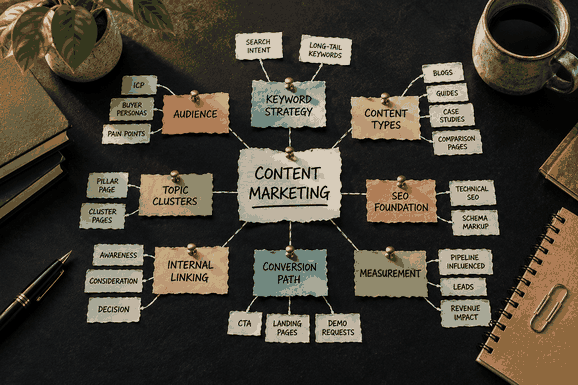
- Content marketing for pipeline growth creates intent-driven content that moves buyers from awareness to purchase.
- It benefits B2B marketing teams, demand gen managers, and founders aiming for qualified organic leads.
- Core components include keyword strategy, technical SEO, funnel-aligned content, search optimization, and internal linking.
- Traffic without pipeline intent is vanity; focused content drives leads sales can close.
Why Content Marketing Often Fails to Drive Pipeline
Many B2B marketers publish content that ranks and drives traffic, but that traffic rarely converts into qualified leads. The root cause is a mismatch between the content’s intent and the buyer’s intent. This same mismatch drives marketing spend conversion problems more broadly. Budget keeps rising, but pipeline stays flat, because the system downstream from awareness is broken. Blog posts targeting broad informational keywords attract readers at the awareness stage. But without nurturing systems, these visitors leave without moving toward a purchase. Pairing content marketing with a structured demand generation system fixes this. It nurtures awareness-stage visitors into pipeline instead of losing them after a single visit.
Pipeline-driving content targets keywords buyers use while comparing vendors, validating options, or justifying decisions. These queries signal real purchase intent, so the leads they produce are more likely to convert.
The Intent Gap Between Traffic and Pipeline
The content types that generate the highest pipeline influence are not always the ones with the highest search volume. Comparison pages, solution-specific landing pages and use-case content consistently convert at a higher rate than general blog posts. This is because they intercept buyers mid-evaluation. When someone searches for a specific solution category or compares two platforms, they are already in buying mode.
Building your content architecture around those intent signals, rather than raw search volume, is the first strategic shift. It is what separates pipeline-focused content from traffic-focused content. This is the same insight that drives effective SaaS demand generation: intent is what converts, not volume.
Building a Keyword Strategy Around Buyer Intent
Start your keyword strategy with your ideal customer profile (ICP), not just a keyword tool. Your ICP is defined by your GTM strategy. If that has not been clearly defined yet, the keyword strategy built on top of it will reflect the same gaps. Understand the questions your buyers ask at every stage. These include their problems, the solutions they explore, and the criteria they use to choose vendors.
High-intent keywords are often longer and more specific, like “best [solution] for [industry]” or “[product] vs [competitor].” These indicate evaluation mode, the stage where you want to capture leads.
Funnel-Stage Keyword Mapping
Effective keyword strategy maps terms across three buyer stages. TOFU content targets problem-awareness queries and builds early brand familiarity. MOFU content targets solution-exploration queries where buyers are learning what categories of tools exist. BOFU content targets vendor-comparison and purchase-validation queries where buyers are ready to talk to sales.
- Awareness-stage: Problem awareness queries to build early familiarity
- Exploration-stage: Solution exploration queries to educate buyers on options
- Decision-stage : Vendor comparison and purchase validation queries to drive demos and sales
Most B2B content programs are heavy on awareness-stage content and thin on decision-stage content. Running a marketing funnel audit is often the fastest way to find exactly where in the funnel your content generates traffic without converting it into pipeline. Fixing that imbalance has a direct, measurable impact on pipeline. Do this by producing more comparison content, vendor alternative pages and solution-specific landing pages.
Technical SEO as the Foundation for Pipeline Growth
No matter how great your content is, technical SEO issues can block it from ranking. Our guide on B2B SEO strategy covers the full technical and keyword foundation. B2B startups need to build this before scaling content production. Crawl errors, slow page speeds, broken links, and poor mobile usability reduce organic traffic before buyers even see your content.
Focus technical SEO fixes on pages closest to conversion pricing, demo requests, and solution comparisons. Fixing issues here delivers faster pipeline results than adding more content to a broken site.
Schema Markup and Search Optimization for Visibility
Schema and structured data help search engines understand your content purpose and format. For pipeline content, FAQ schema on solution and comparison pages can create rich search results. These results stand out and improve click-through rates.
Other useful schema types include breadcrumbs, reviews, and how-to guides. Many B2B teams underuse these and miss an easy visibility boost. It costs nothing to implement, and it can significantly improve the click-through rate on pages that already rank.
Content Architecture That Compounds Organic Traffic
Pipeline-focused content is a connected system, not isolated pages. Use topic clusters with pillar pages covering broad topics and cluster pages diving into subtopics. Internal links between them build authority and guide buyers through their journey. Alongside internal linking, marketing automation workflows handle the nurturing layer. This layer moves buyers from content consumption to pipeline stages automatically.
Internal Linking for Funnel Progression
Internal linking is a powerful but underused tactic. It should connect awareness-stage content to solution and decision-stage pages, mirroring how buyers move through research and evaluation.
Links must align with buyer intent, guiding visitors naturally to the next step. For example, from a blog post to a comparison page or demo request. For SaaS companies specifically, internal linking architecture should mirror the sales motion defined in your B2B SaaS GTM strategy. It should guide product-led or sales-assisted buyers through different paths based on their evaluation stage. This turns traffic into pipeline progression, not single visits.
Measuring Content Marketing Impact on Pipeline
Most content teams struggle to prove pipeline impact because they focus on sessions and rankings instead of leads and deals.
Connect your CRM with analytics using UTM tags and lifecycle tracking to see which content influences the pipeline. This data helps shift budget toward content that drives real revenue, not just traffic. For teams running paid marketing alongside organic content, the same pipeline attribution data helps too. It can guide how you allocate between channels, based on cost per opportunity rather than cost per click. Our guide on marketing metrics covers the measurement framework that connects content performance to pipeline and revenue. Use it to shift budget toward what actually drives deals.
Most B2B marketers already have content that could generate qualified leads. The missing piece is strategy, not volume. Whether you need a content audit, keyword strategy overhaul, or technical SEO fixes, start with a conversation.
Frequently Asked Questions
- How to Hire Your First Operational Team: Early Hires and a Scaling Playbook
- Full-Stack Venture Studio Outcomes: Multi-Function Results and Founder Success Stories
- The Six Functions of a Scalable Business: Growth Infrastructure and Systems Thinking
- Startup Operations and Growth Framework: The Founder's Guide to Scaling With Systems