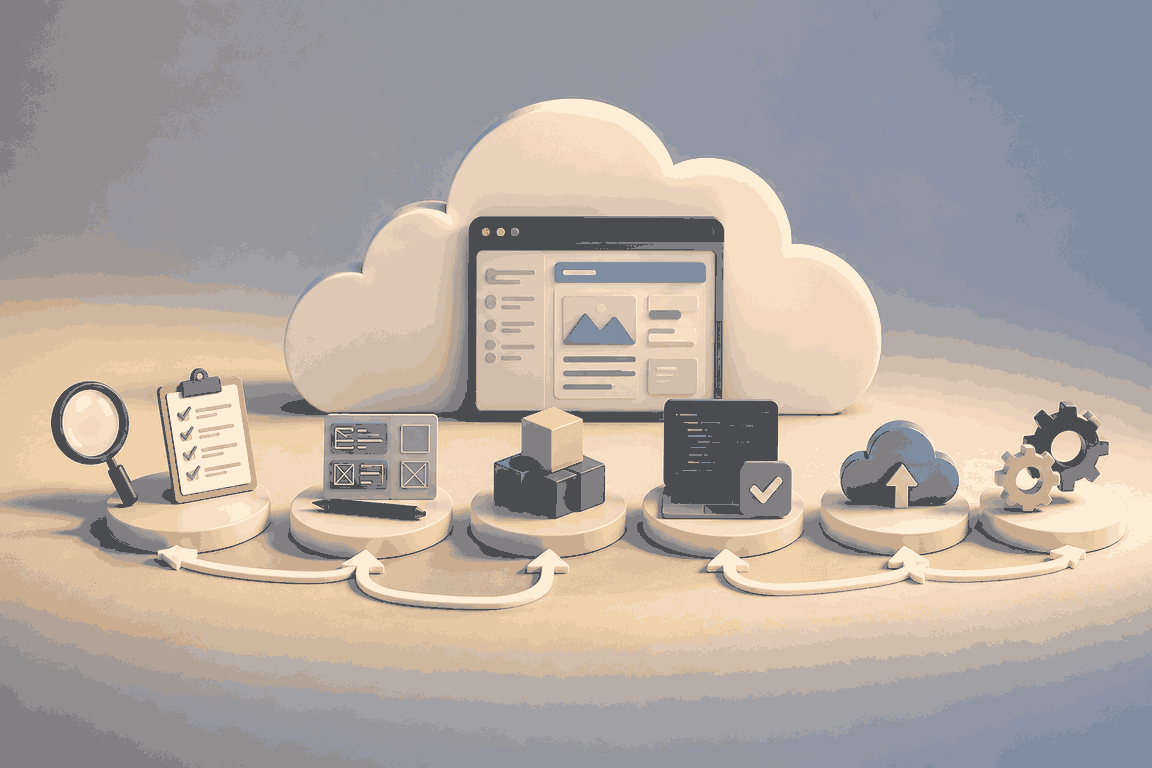
- SaaS development means building cloud-delivered software that is centrally maintained, subscription-based and accessed via browsers or APIs rather than installed locally.
- The development lifecycle runs through six stages: discovery, architecture and prototyping, MVP, full-scale build, deployment and ongoing maintenance.
- Core services include consulting, architecture design, custom development, migration, third-party integrations and post-launch support.
- Choose the right partner by defining your needs first, then evaluating technical expertise, delivery style, post-launch support and client references.
- Aligning your development roadmap with your go-to-market strategy from day one reduces time-to-revenue and prevents costly late-stage rework.
What Is SaaS Development?
SaaS development means creating software that lives in the cloud. Users access it through browsers or APIs, instead of installing it on individual computers. Unlike traditional software, SaaS products are centrally maintained, updated automatically and licensed via subscriptions.
This process covers everything from early discovery and design to deployment, maintenance and regular updates. Today, SaaS powers about 85% of business applications. Large enterprises use an average of 177 SaaS tools every day.
SaaS Application vs. SaaS Platform
- SaaS applications solve specific problems (like project management or payroll).
- SaaS platforms go further, offering APIs and development tools so others can build apps on top of them.
- SaaS development is really a specialized branch of software development, distinguished by multi-tenancy, subscription billing and continuous delivery rather than one-off project builds.
The SaaS Application Development Lifecycle
A well-structured development process helps you avoid costly mistakes, test your ideas early and align each step with your business goals. Here’s how it typically unfolds:
Discovery and Market Validation
Before coding begins, research your market, competitors and users to confirm real demand. About 42% of startups fail because they target a market that’s too small. If your product relies on a genuinely new technical capability, this is also the stage to run a structured proof of concept . It's a faster, cheaper way to de-risk the core assumption before you discover it doesn't hold once the MVP is half-built.
Architecture and Prototyping
Translate your vision into clear specs, design and a prototype. Key decisions here, like cloud provider and data strategy, impact your app’s performance and cost. Getting the cloud provider and data strategy right here matters. It's what separates scalable product architecture from a system that needs an expensive rebuild once usage climbs.
The discipline behind this stage is the same one that governs MVP development for startups more broadly. Build only enough to answer the riskiest question, not to impress anyone.
MVP Development
Build a Minimum Viable Product with just the essential features. This approach speeds up time-to-market and gathers valuable user feedback without heavy investment.
Full-Scale Build and Quality Assurance
Develop the complete product with robust infrastructure, security, integrations and thorough testing to ensure reliability and compliance.
Deployment and Go-Live
Launch with automated pipelines, monitoring systems and incident response plans to keep your app running smoothly.
Maintenance, Support and Iteration
After launch, provide ongoing support, regular updates, security patches and infrastructure improvements to keep users happy and your app competitive.
Core SaaS Development Services
Top SaaS development partners offer a full range of services to meet your needs at every stage:
- SaaS Consulting: Craft a clear product roadmap based on your goals and market.
- Architecture and Prototyping: Design scalable, secure cloud solutions and create prototypes to validate UX.
- Custom SaaS Development: Build backend, frontend, databases and integrations with expertise in AWS, Azure or Google Cloud.
- Migration: Seamlessly move from legacy software to SaaS with minimal disruption.
- Third-Party Integrations: Connect your app to CRMs, payment systems, ERPs and analytics platforms.
- Support and Maintenance: Keep your SaaS product running smoothly with bug fixes, security updates, scaling and new features.
How to Choose the Right SaaS Development Partner
Picking the right vendor is one of the most important decisions you’ll make. Here’s a simple framework:
- If you want a deeper, side-by-side comparison framework, our guide to evaluating SaaS development partners covers the criteria that matter most at the shortlisting stage.
- Define Your Needs: Document your product scope, architecture, budget, timeline and internal capacity before reaching out.
- Check Technical Expertise: Look for cloud certifications, relevant project experience, security credentials and published technical insights.
- Evaluate Collaboration Style: Understand their project management approach, communication, sprint reviews and flexibility.
- Confirm Post-Launch Support: Ensure they offer ongoing maintenance, SLAs and scalable account management.
- Ask for References: Talk to clients with similar projects about delivery quality, communication and whether they’d hire the vendor again.
Sync SaaS Development with Your Go-To-Market Strategy
A clearly defined B2B SaaS GTM strategy is what makes the alignment below possible in the first place. Without it, development and sales end up building toward different definitions of the ideal customer. Successful SaaS products build their sales strategy and development roadmap in tandem. Here’s how to align them:
- Match Features to Your Ideal Customer: Prioritize features that deliver quick value to your main buyers, reducing churn and speeding sales cycles.
- Design for Your Sales Motion: Whether it’s product-led growth with easy onboarding or enterprise sales needing compliance features, build what your sales model requires. Getting this right depends on having a clearly defined sales strategy before development starts, not one that gets retrofitted once the product is already built around the wrong assumptions.
- Plan Pricing Early: Your billing model (per seat, usage-based, tiered) must be supported by your app’s architecture from day one.
- Leverage Integrations: Enterprise buyers expect strong integrations with top CRMs, marketing tools and ERPs. Prioritize these to ease purchasing decisions.
Evaluating SaaS Development Proposals
When you get proposals, compare them on these points to make a fair choice:
- Clear scope and deliverables
- Named senior team members dedicated to your project
- Technology choices that fit your needs (not just vendor preference)
- Milestones tied to business goals
- Risk awareness (e.g., API dependencies, compliance)
- Transparent pricing and change management
- Clear IP and data ownership terms
- If your scope also includes a marketing site or customer-facing web property alongside the core SaaS product, it’s worth evaluating that piece separately-our guide to comparing web development vendors covers the criteria specific to that kind of build.
Get a free consultation to discuss your project timeline, costs and risks. No strings attached.
Frequently Asked Questions
It's the full process of designing, building, deploying and maintaining cloud-based software delivered via subscription.
Product consulting, UX/UI, MVP and full development, cloud setup, integrations, security, testing, deployment and ongoing support.
Look for technical expertise, relevant experience, security, delivery approach, client references and support capabilities.
MVPs usually take 3 to 4 months. Full products take 6 to 9 months. Complex enterprise solutions take 12 or more months, depending on scope and integrations.